

Counter-Strike vs. Valorant: the battle for esports shooter supremacy
The global esports industry has reached unprecedented heights, becoming a battleground for dominance across every genre. Shooter games, one of the cornerstone genres of gaming, hold a particularly prominent position. Among these, the rivalry between Counter-Strike and Valorant stands out as one of the most heated in the esports landscape. Both titles command enormous audiences and represent the pinnacle of team-based shooter competition.
Counter-Strike has been a titan of esports for decades, maintaining its status as a genre-defining game. Its transition to the latest version in 2023, Counter-Strike 2, has further reignited its player base and viewership. Valorant, on the other hand, was crafted from the ground up as a direct competitor to Counter-Strike. Since its launch in 2020, it has seen extraordinary success, rapidly gaining popularity and establishing itself as a global esports powerhouse in under five years.

So, when it comes to viewership, which is better, Valorant or Counter Strike? How do their growth trajectories compare, and what trends are emerging in this fierce rivalry? This viewership analysis explores the ongoing battle between the two titans.
Counter Strike and Valorant esports: General content trends and audience dynamics
When looking solely at the total viewership for esports content (excluding Chinese livestreaming platforms), Valorant has seen consistent growth in watch time since its release, while Counter-Strike shows a dip in 2023. However, this decline isn’t a result of waning audience interest. It stems from a key update following the release of Counter-Strike 2: the switch from the traditional MR16 format (requiring 16 round wins to secure a map) to MR12 (requiring only 12).
The rationale behind this change was clear. Under the MR16 system, best-of-three matches (classic and widely used in competitive play) frequently ran longer than any other esports events and even surpassed the length of some traditional sports, including football, ice hockey, and even marathon games like baseball or American football. Shortening the matches not only streamlined tournaments but also naturally reduced airtime, leading to a drop in watch time statistics.
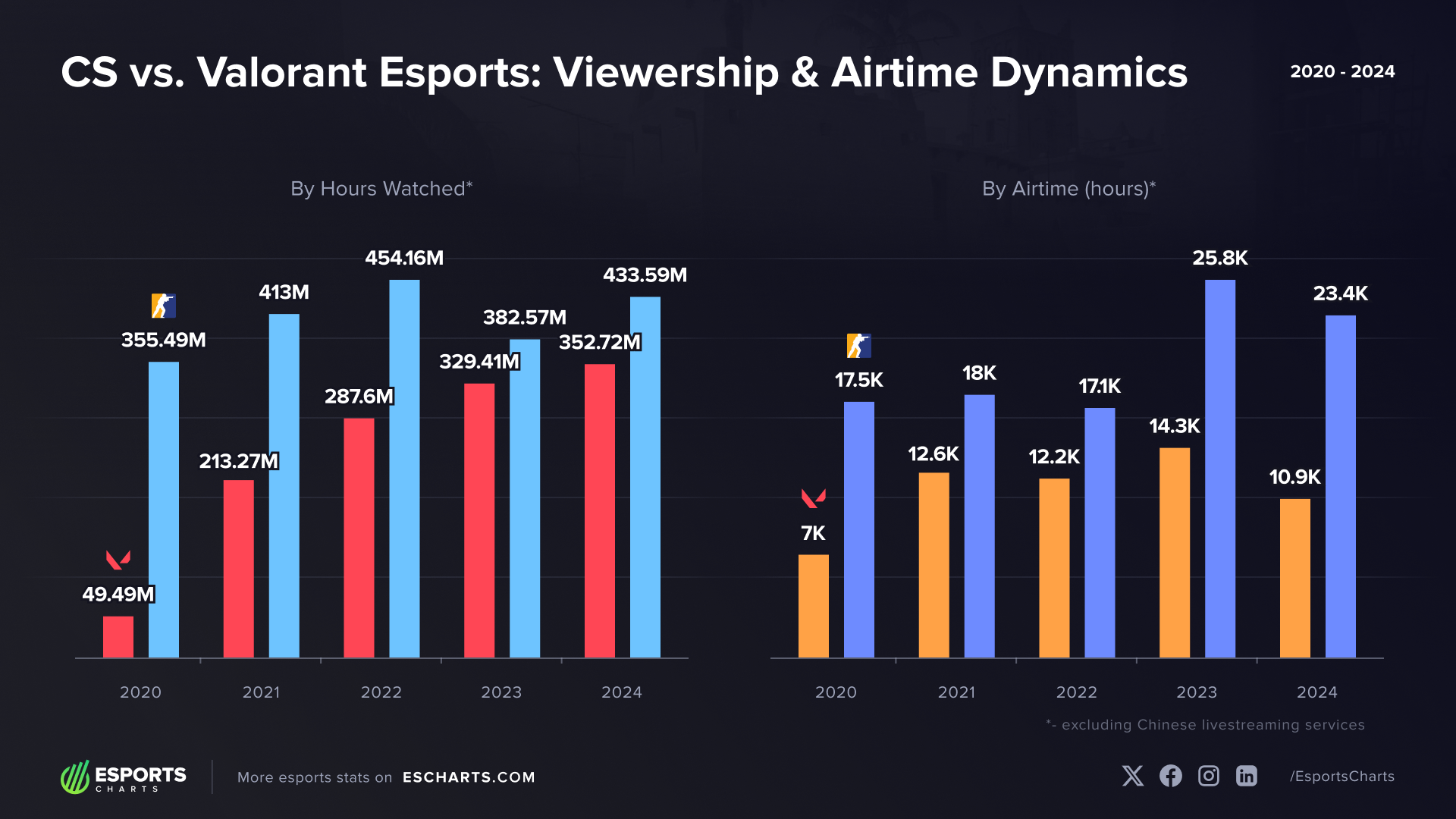
Valorant, meanwhile, has enjoyed steady growth, thanks largely to Riot Games' strategic approach to building its esports ecosystem. In the game's first year, there was no formal competitive circuit, only a variety of third-party events held across the world. Riot initially tested the waters with the First Strike regional events to assess the game's competitiveness and viewership potential. By 2021, the Valorant Champions Tour (VCT) was established, encompassing major regions from North America to Southeast Asia. The circuit included regional competitions, international Masters events, and the year-defining Valorant Champions finale. This system, albeit with ongoing modifications, remains at the core of Valorant's esports scene, driving its continuous development and popularity.
In 2023, Valorant came closer than ever to matching its competitor in total live esports viewership, trailing by only 14%. This was a significant milestone in the rivalry between the two shooters. For comparison, during Valorant’s launch year, its esports viewership lagged 86% behind Counter-Strike’s. The gap steadily narrowed over time, shrinking to 48% in 2021 and 36.6% in 2022. Although it widened slightly in 2024 to 18.6%, 2023 remains a landmark year for Valorant’s competitive scene.
Two major factors contributed to the narrowest gap being reached in 2023. First, Riot Games' experimental and immensely successful LOCK//IN tournament at the beginning of the season made waves. It was the largest international Valorant event to date in terms of team participation, featuring 32 of the world's top squads, compared to the usual 8 to 12 teams seen at international events. This format generated significant hype, especially since fans were eager to see the newly formed rosters in action at the start of the season.

Secondly, 2023 marked a transitional year for Counter-Strike, not just because of its move to CS2, but also due to the scheduling of only one Valve’s Major event that year, down from the usual two. With fewer primary events in Counter-Strike's competitive calendar, Valorant was able to close the viewership gap a little.
Counter Strike and Valorant esports: Regional audience preferences
Speaking of regional audience preferences, one key trend that has emerged in both titles over recent years is the decline in the share of English-language broadcasts in the overall viewership. For instance, in Valorant, the share of English broadcasts was over 50% in its launch year, while in Counter-Strike, the share of English-language streams has dropped from over 70% in 2016 to just 42% in 2024.
Looking to unlock advanced esports stats on our site? A Pro subscription gives you detailed insights on tournament and team audiences, with even more data available in our dashboards. For a fully comprehensive view, check out our enterprise solutions.
The primary Counter-Strike audience is spread across North America, Europe, Brazil, and Russian-speaking post-Soviet countries. The share of other languages in total watch time has never surpassed 5%, with Polish, Spanish, and Vietnamese being the most significant secondary languages. Interestingly, some lesser-known languages have experienced viewership spikes due to the success of local teams. For example, in 2024, Mongolian-language streams hit new highs, thanks to The MongolZ, a local team that has recently been consistently ranked in the top 10 worldwide across various rankings, including Valve and HLTV.
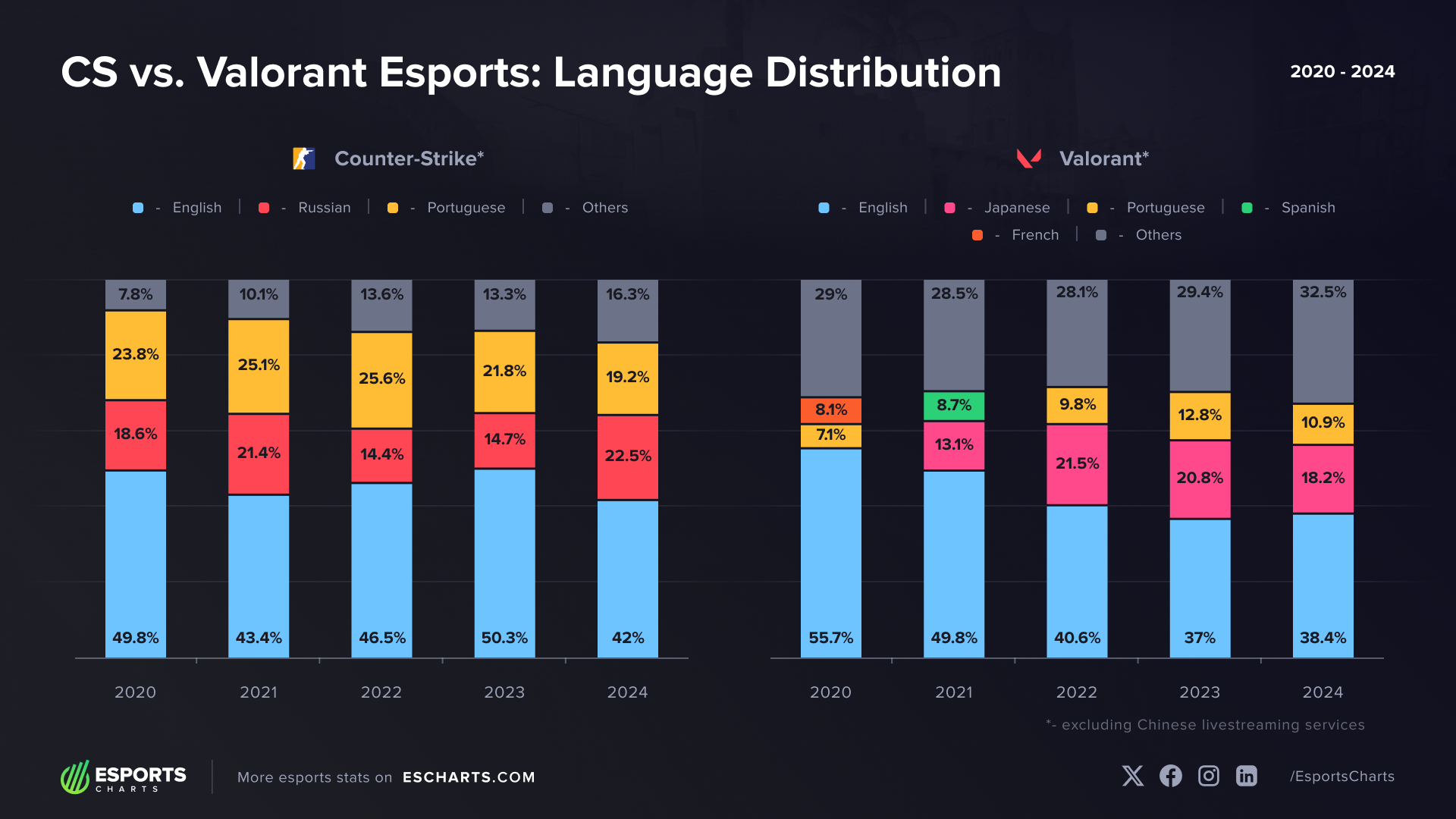
One significant aspect of Counter-Strike’s regional audience development is the increasing influence of Russian-speaking countries. These regions now feature a growing number of both teams and players actively participating in Counter-Strike. This rise in involvement is also reflected in the increasing presence of co-casters, with more third-party streamers covering major events. As a result, Russian-speaking fans have become more engaged, fostering a deeper connection to the competitive scene. The success of teams like Team Spirit in 2024, which showed impressive growth and continued to capture the attention of fans, has further solidified this trend, especially among Russian-speaking audiences.
Brazil, another key region for Counter-Strike, has long had a strong presence in the competitive scene. Brazilian fans have shown unwavering enthusiasm, especially when local teams like FURIA perform well on the international stage. However, recent years saw a slight dip in Brazilian viewership, as local teams struggled to make significant waves at international events. The Brazilian fanbase, however, remains passionate, and any resurgence of success by teams like FURIA or MIBR is sure to drive a rise in viewership once again.
Valorant, unlike Counter-Strike, has a more varied audience across different countries. The dynamics aren't as clear-cut, and there aren't the same steady viewership powerhouses like Brazil or post-Soviet countries. Still, some regions are gradually becoming reliable sources of viewership for the game.

The key difference between Valorant and Counter-Strike in this regard is the game’s greater popularity in Asia, particularly in Japan. Riot Games made a strong push to promote the game in the country through local content creators, which is considered one of the most important (if not the most important) factors in the game’s success there. The success of local teams on the international stage also played a huge role: for example, ZETA DIVISION, one of Japan’s top teams, took third place at the Valorant Masters Reykjavík 2022.
Since the game's launch, Japan has consistently accounted for 15-20% of the total esports viewership for Valorant each year, and this share is likely to grow as long as local teams continue to perform well on the global stage.
Another region with steady but somewhat smaller viewership is Brazil. LOUD, the country’s biggest esports and gaming organization, had a major impact on Valorant's local success in 2022 when they won the Valorant Champions, the equivalent of the World Championship. Brazil now regularly accounts for just over 10% of Valorant’s total viewership.
An important reason for Valorant’s more diverse viewership compared to Counter-Strike is the way the game’s broadcasts are structured: Riot has put a major focus on co-casting as an alternative to official broadcasts. As a result, the audience is split almost equally between both, with content creators from around the world, from Japan and Korea to Brazil and Latin America, bringing the game to a wider audience.
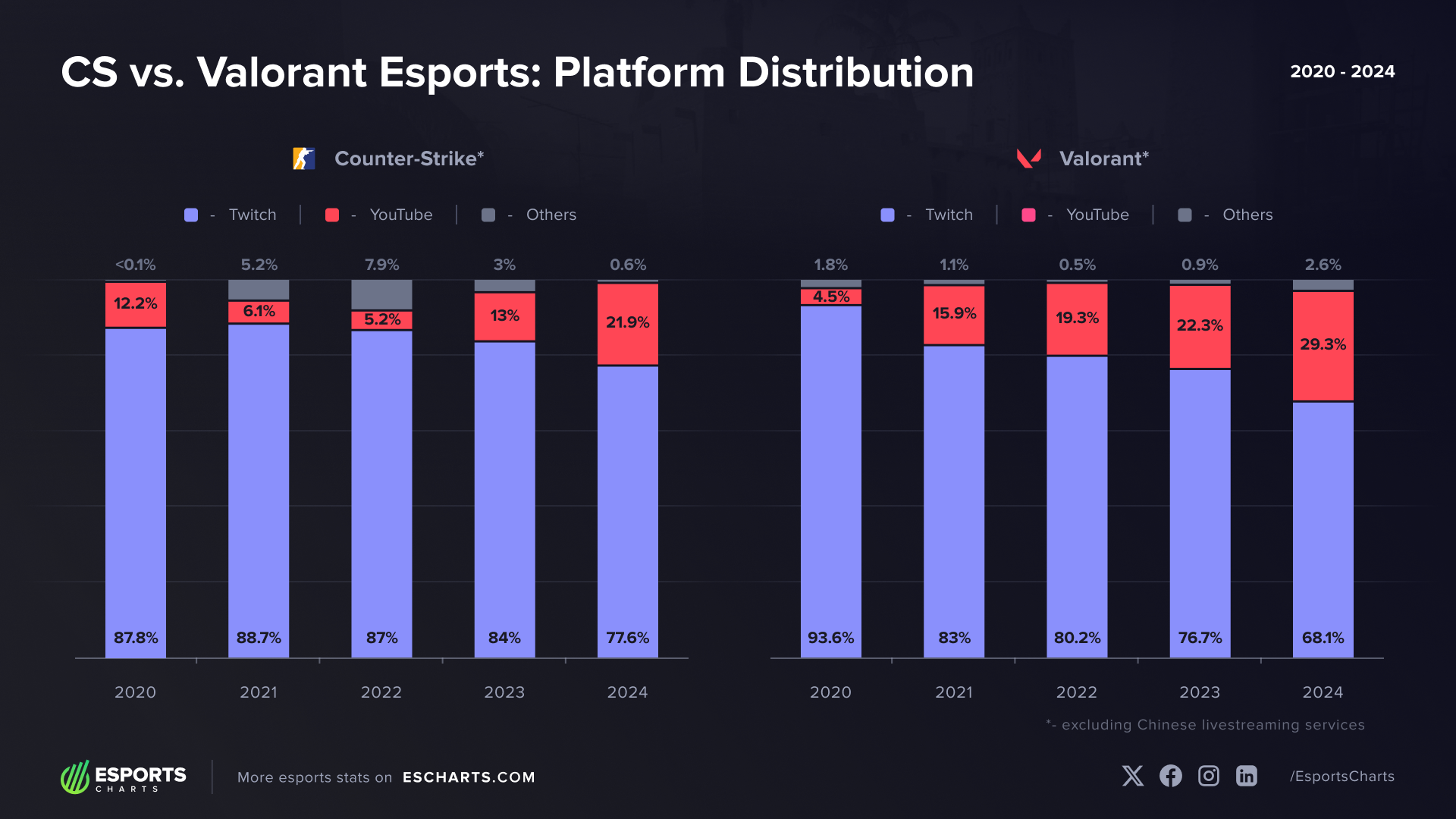
The regionalisation of Valorant and Counter-Strike broadcasts is significantly shaping how esports content is consumed across various platforms. While Twitch remains the dominant platform for both games, there's a clear trend of its share steadily shrinking as other platforms grow in influence.
This decline in Twitch's share is primarily linked to YouTube's growing presence, particularly in Asia, where the platform has become the go-to for esports viewing. With the rise of multicasting, no high-profile tournament for Valorant or CS now takes place without streams on YouTube, whether official or third-party.
As regional preferences continue to diversify, the influence of additional platforms is increasing, especially for Valorant. Fans can now access tournament streams not only on YouTube but also on platforms like TikTok and region-specific services such as Chzzk and SOOP Korea, which are particularly popular in South Korea. This broadening of platforms further amplifies the reach of esports content, offering a more diverse range of viewing experiences tailored to regional audiences.
Counter Strike & Valorant: Most popular teams
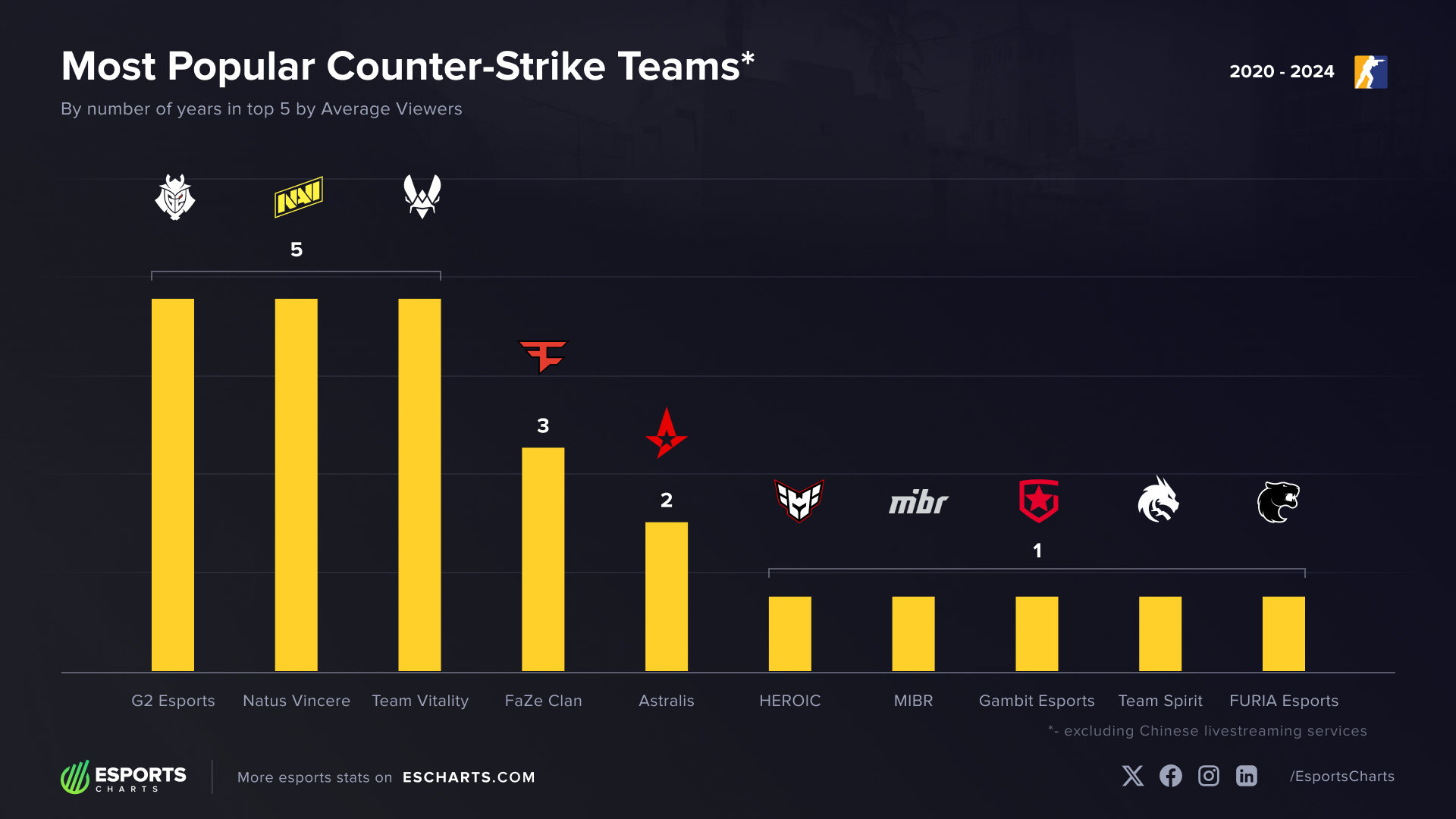
In the Counter-Strike esports scene, the primary drivers of the game's popularity are mostly teams based in Western Europe. In recent years, the top teams that consistently capture attention include G2 Esports, which has built a large English-speaking fanbase, Natus Vincere, which attracts viewers from Ukraine and Russian-speaking countries, and Team Vitality, which shifted from a French-only roster to an international one, significantly expanding its global reach. Additionally, Brazil plays a major role in Counter-Strike's audience: during successful years, teams like FURIA and MIBR draw in large viewership numbers.

Overall, the Counter-Strike competitive scene has remained more stable than Valorant's, especially in terms of team rosters. Major reshuffles are rare, and the top 30 teams tend to stay consistent. In contrast, Valorant has experienced more stability only over the last 1-2 years, following the introduction of a partner system for teams and the establishment of a clear, structured esports season, which now includes regional leagues and major international events.
Due to the increasing regionalisation of the Valorant esports scene, the top teams come from a variety of regions, with Sentinels standing out as a prominent force: they’ve gathered some of the most popular players (and just as importantly, co-streamers) from North America. Following closely in terms of popularity are DRX (South Korea), Fnatic (Europe), Paper Rex (Singapore), and LOUD (Brazil).
***
The rivalry between Counter-Strike and Valorant continues to captivate the esports world, with each game carving out its own niche and growing its audience in distinct ways. Counter-Strike, with its long-standing history and well-established competitive ecosystem, maintains a stronghold in regions like Western Europe, Russia, and Brazil, where its stable team rosters and iconic teams like G2 Esports and Natus Vincere continue to attract large, dedicated fanbases. In contrast, Valorant’s rapid rise since its 2020 launch has been marked by an impressive regional expansion, particularly in Asia and South America, and its strategic use of co-streaming and diverse content creators has fueled its global success.
Although both games have seen fluctuations in viewership, Valorant has managed to close the gap in recent years, thanks to its flexibility and innovations like the partner system and regional leagues. However, Counter-Strike still reigns supreme in the esports shooter scene, and any competitor looking to dethrone it will have to put in serious effort. Regardless of who is currently on top, the two titles have produced some of the most iconic moments in esports, and the battle is likely to continue for years to come.

Dados de Esportes detalhados na ponta de seus dedos.
Inscreva-se em e comece a explorar!


