
LPL and CBLOL defy gravity as LCP audience vanishes
With the First Stand tournament set to begin this Monday, the global League of Legends community is turning its focus to the teams representing their respective regions. As we prepare for the international debut of this season's top competitors, it is worth looking back at the viewership data and audience dynamics of the winter splits that brought us here.
While most regions demonstrate positive growth or stable development, the data shows a significant divide in performance. Several leagues have successfully navigated format changes and team-composition shifts, but one specific region faced a sharp decline across all key indicators due to a combination of structural and external factors.
LCK (South Korea)
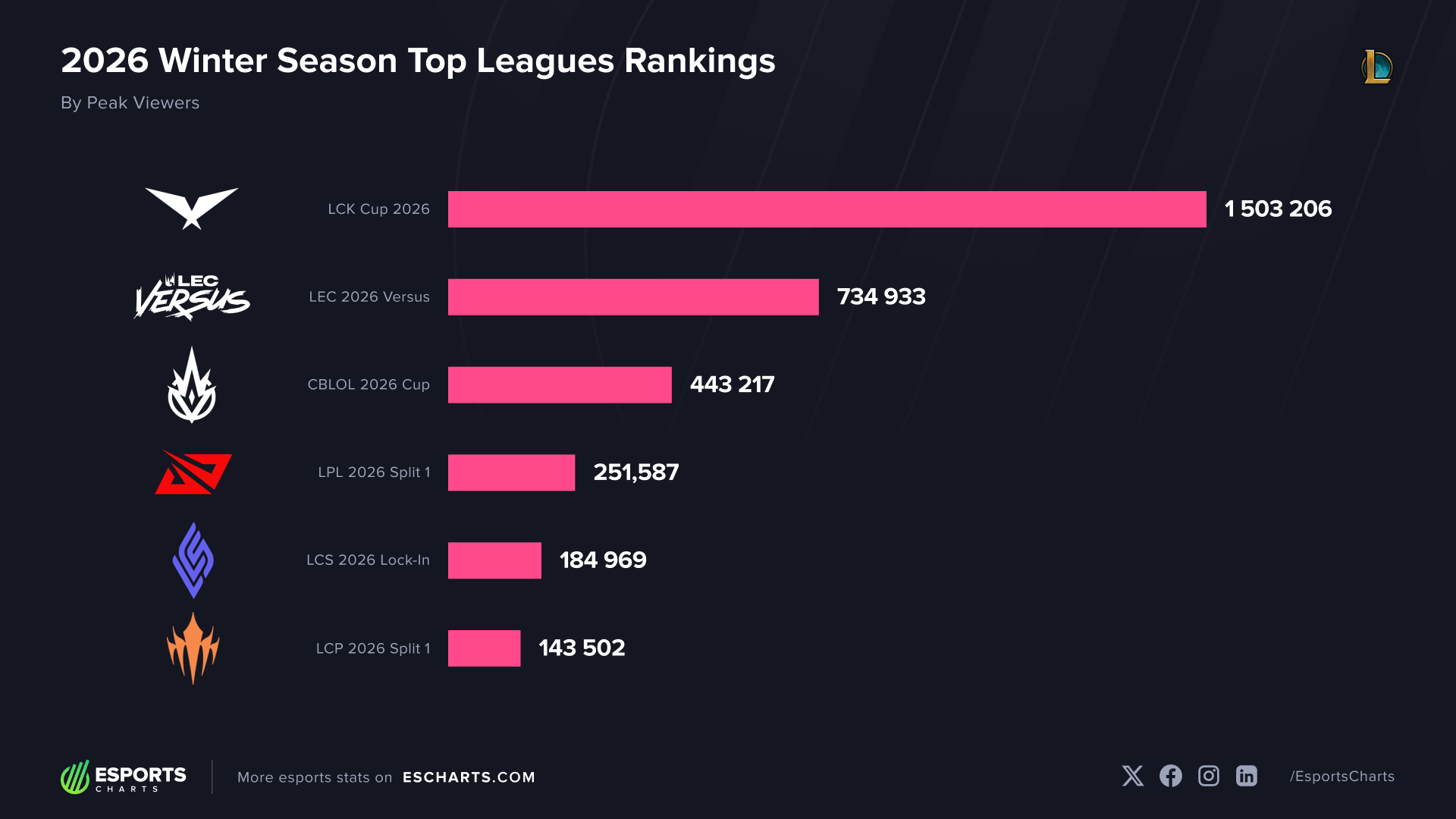
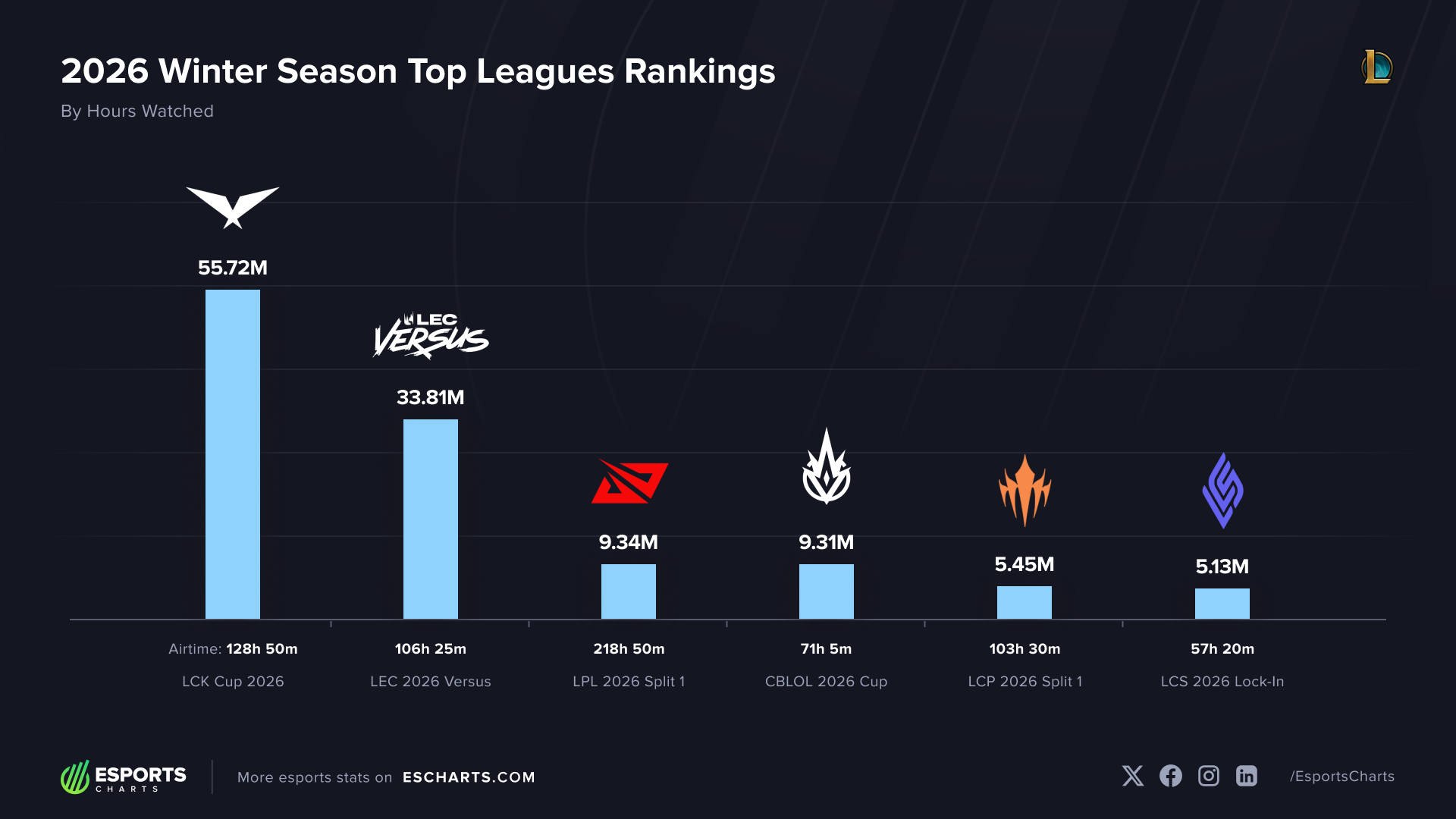
The LCK maintained its established structure this winter but still saw a shift in key metrics. A lower number of “clean” 2:0 series resulted in longer broadcast time. Combined with a slight increase in Average Viewers, this pushed total Hours Watched (HW) significantly higher.
However, the league likely missed out on even stronger results. T1, the main driver of viewership in the region, suffered an unexpectedly early playoff exit. As a result, while overall metrics remain strong, peak viewership fell short of the records the league might have reached had its most popular team advanced to the finals.
LEC (EMEA)
The LEC’s winter experiment produced clear results. The addition of two popular ERL teams, Los Ratones (NLC) and Karmine Corp Blue (LFL), provided a notable boost to overall audience interest. Matches involving Los Ratones were particularly successful, attracting strong attention from viewers across the EMEA region.
Although average viewership dipped slightly compared to Winter 2025, the tournament featured a larger number of matches. This expanded schedule helped keep total Hours Watched on an upward trajectory. Peak viewership declined slightly, though the drop was not significant enough to suggest any structural problems for the league.
CBLOL (Brazil)
CBLOL returned this year as a standalone tier-1 league following the end of the LTA experiment. The winter split also saw the integration of Leviatán from Argentina, which joined the Brazilian circuit after the dissolution of the LLA and LTA leagues.
Comparing Hours Watched with last year’s LTA South split is difficult due to the shortened regional format used at the time. However, peak viewership clearly tells a positive story. CBLOL recorded the largest percentage increase in the metric among all major leagues this winter, proving the continued strength of the Brazilian broadcast as an independent product.
LCS (North America)
With the return of the LCS brand, the league appears to have stabilized its audience. The team lineup remains largely unchanged, with the main roster update being Sentinels replacing 100 Thieves. The shift to a more comprehensive format, including a full group stage and playoffs, also contributed to an increase in Hours Watched.
Peak viewership also trended upward compared to Winter 2025. While this marks a positive development for the region, the league still has not reached the viewership levels seen during the earlier peak years of the LCS.
LPL (China)
The LPL introduced several major changes this year. The number of participating teams was reduced from 16 to 14 following the exits of FunPlus Phoenix and Royal Never Give Up. At the same time, the league implemented a new multi-stage group format along with a draft system designed to add more variety to matchups.
Despite the smaller field, the LPL recorded a significant increase in Hours Watched compared to Winter 2025, largely due to the new format. Most notably, the league achieved its highest peak viewership in two years, reflecting growing international interest in the LPL beyond mainland China.
LCP (Pacific)
The LCP was the only league to decline across all major metrics compared to Winter 2025. Several factors contributed to this downturn, including the early elimination of fan favorites GAM Esports and CTBC Flying Oyster, the departure of PSG Talon, and a high level of roster turnover across the league.
In addition, the decision to move broadcast start times earlier appears to have reduced accessibility for key viewer groups, particularly working audiences and students.
First Stand begins
The first international clash of 2026 starts next Monday, March 16. All the essential details regarding the format, participating rosters, and match schedules can be found in our comprehensive First Stand 2026 guide.

Dados de Esportes detalhados na ponta de seus dedos.
Inscreva-se em e comece a explorar!


