

New format, new heroes — VCT 2022 Stage 1 Masters group stage results
The group stage of VCT 2022: Stage 1 Masters Reykjavík ended last night. Two best teams of quartets A and B advanced to the playoff stage. Esports Charts tells you about the new format, results and viewership statistics of the first stage, and also compares it with the Masters tournament held in Berlin last year.
VCT 2022 Stage 1 Masters: Group Stage Results
We cannot say that the results of both groups were predictable. Korean team DRX (former Vision Strikers roster) took the first place in quartet A: it didn’t lose a single map to the competitors, while the second place was unexpectedly taken by the Japanese team ZETA DIVISION, which was considered one of the outsiders in the event.
ZETA predictably lost their first match to DRX, but then successfully defeated a weakened Fnatic roster: in late March, Russian player BraveAF went inactive, and a Finnish player of Russian descent, Derke, was unable not play in the Masters group stage. In the decisive match, however, the Japanese team beat a strong Brazilian roster of Ninjas in Pyjamas making an impressive comeback on the last map and reaching the decisive stage of the international Valorant event for the first time.
ZETA's moment of victory over NiP on the TenZ stream
Group B had some surprises as well: XERXIA (former X10) and world championship semifinalist KRÜ Esports couldn't make it to the playoffs. Team Liquid took the top place in the quartet, and there was a big battle for second place between XERXIA and OpTic Gaming. These teams have met many times in international events: for example, X10 did not let the Americans (at that time the team was playing under the Team Envy tag) to reach the Valorant Champions playoffs last year, and at the current Masters, the team from Thailand left no chance for OpTic in the opening game. But in the decisive game for the playoffs Pujan FNS Mehta's squad was stronger.
Group Stage Viewership Statistics
Riot Games keeps experimenting with the VCT Masters group stage format. We should remind you that at the first international event of the series, the company completely abandoned the group stage, and there was a full-fledged stage at the tournament in Berlin, where all the participants competed. Now the stage was held in a shortened format: there were only two groups with four players in each, and the winners of Stage 1 Challengers from Europe, North America, Asia-Oceania, and Brazil automatically received playoff slots.
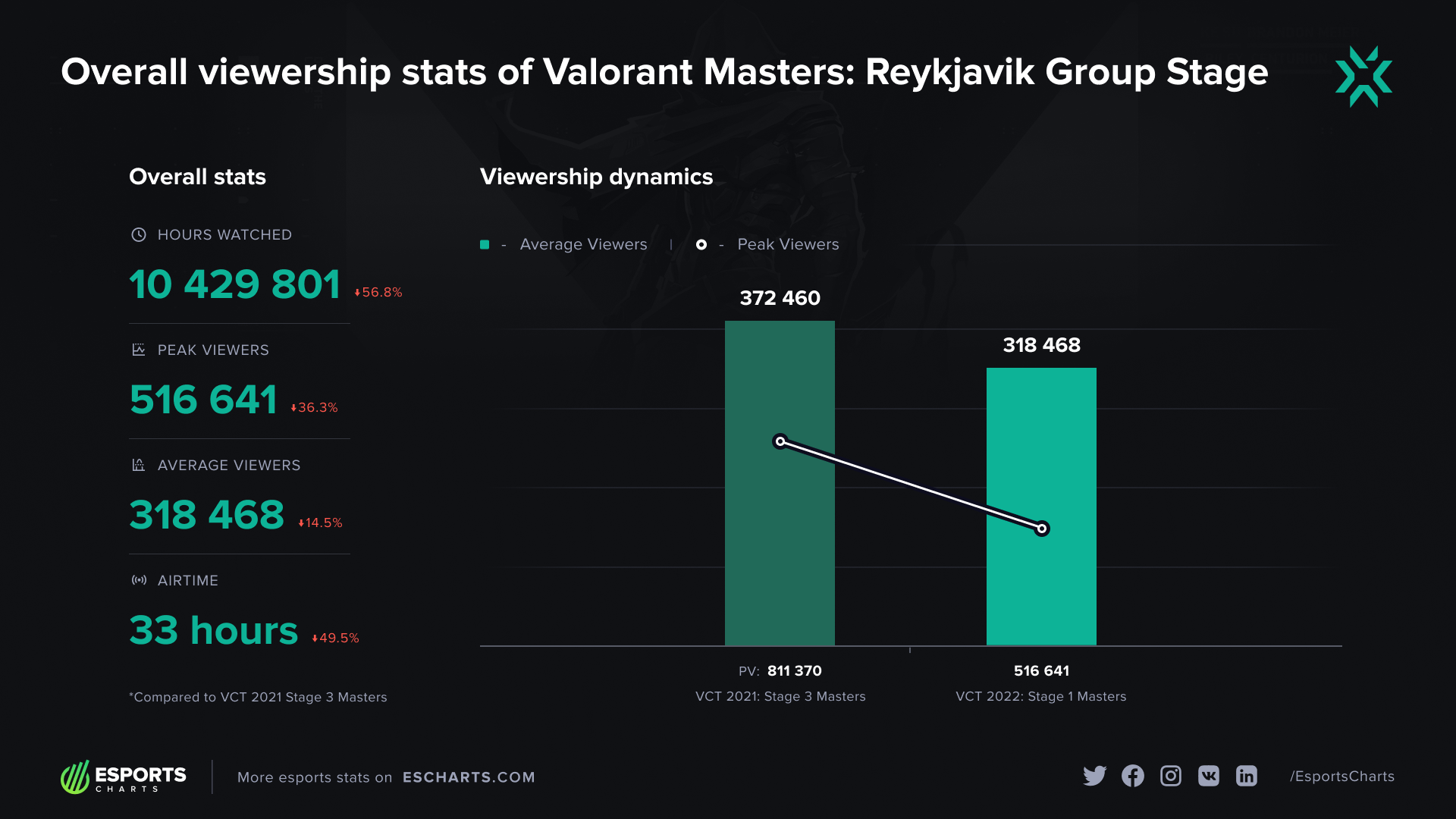
Due to the shortened format, the group stage airtime significantly decreased — almost twice as much as compared to Berlin Masters (64.8 hours vs. 32.7 hours). Similarly, the total number of stage's Hours Watched dropped by 57%, to 10.4 million HW.
Because the best teams in the strongest regions advanced directly to the playoffs, not all fans of the competitive Valorant watched the group stage. The Average Viewers number was 14.5% fewer compared to Berlin (318.4K Average Viewers), and the most popular stage’s match attracted 36.3% fewer Peak Viewers than the top game of the Berlin tournament.

The most popular matches of the group stage featured the Japanese team ZETA. Its opening game against the Koreans from DRX drew the largest Peak Viewers number — 516K spectators. In second place is the match against NiP, which was watched by up to 507K Peak Viewers.
Besides ZETA, the fans of NiP from Brazil were also extremely active. The team had three matches out of the top 5 of the group stage: against ZETA, DRX and Fnatic. It should be noted that ZETA and DRX are the leaders of the stage by total Hours Watched.
Statistics on the most popular teams are available with a PRO subscription

The absence of the top teams in the group stage affected the statistics of the broadcast languages. Most of the most popular languages, including English, Spanish, and Turkish, dropped in Average Viewers. At the same time, the numbers for Japanese slightly increased, and Portuguese as well as Thai showed the most growth.
It should be noted that there were new broadcast languages compared to Berlin Masters. These were Czech, Hungarian and Filipino (Tagalog), but their audience was very small.
As for the popularity of broadcast languages, English and Japanese remain in 1-2 places by Hours Watched, while Portuguese moved Spanish from the third place. Similarly, the audience from Thailand this time was more active than the viewers from Turkey.

Due to the reasons mentioned above, the Average Viewers number on all the main coverage platforms of the tournament also decreased. Twitch is still in the lead, attracting 277.8K Average Viewers, and YouTube is in second place, with 40K Average Viewers.
***
The playoffs kick off today, April 14, and the audience of the competition is certain to grow. Popular teams, including G2 Esports for Europe and LOUD from Brazil, will compete in the finals. The match against Team Liquid should be one of the most popular at the tournament.
You can follow the Masters Reykjavík audience statistics on the tournament page.


