

Co-casting of Counter-Strike Majors: how impactful is it?
The countdown is on: the BLAST.tv Austin Major 2025 kicks off on June 2, and millions across the Counter-Strike community are getting ready to tune in, and not just through the official broadcast, but also via the streams of their preferred creators. From seasoned analysts to local fan-favorites, co-streamers will once again play a huge role in bringing the Major to life for viewers around the world.
In recent years, these community casters have become a cornerstone of Counter-Strike Majors, helping tournaments reach bigger, more diverse audiences around the world. But just how much influence do they really have? How does their impact vary across regions? And who stands out as the most powerful voices in the co-streaming scene today? Let’s dive in.
Co-streaming in Counter-Strike has been around for quite some time: independent broadcasters were already covering Majors back in the 2010s. However, it’s only in recent years, during the transition from Global Offensive to the current version, Counter-Strike 2, that co-streamers have begun to truly compete with official broadcasts in terms of reach and impact.

Take PGL Major Stockholm, the first post-pandemic Major: co-streamers made up just 7% of total viewership. Even across the next two events, that share climbed only modestly, to around 14%. The real shift began with the BLAST.tv Paris Major, where co-streamers accounted for a full quarter of the tournament’s viewership. Though, to be fair, that surge was partly driven by a unique factor we’ll explore below.
The turning point came with PGL Major Copenhagen 2024: the first Major where co-streamers actually drew more viewers than the official broadcast. What caused such a sudden spike?
What changed was the organizers’ approach to co-streaming. During the Global Offensive era, it was mostly dedicated CS streamers, often retired pro players, who handled co-casts, usually with a forced delay of several minutes to give priority to studios that paid for regional broadcasting rights.
But lately, cos-treaming has opened up to a broader group of creators, popular streamers for whom Counter-Strike isn’t even a primary focus. Many of them, often backed by betting sponsors, have secured rights to stream tournaments without delay. And judging by today’s co-streaming viewership numbers, that lack of delay has become a powerful tool for pulling viewers away from official broadcasts.
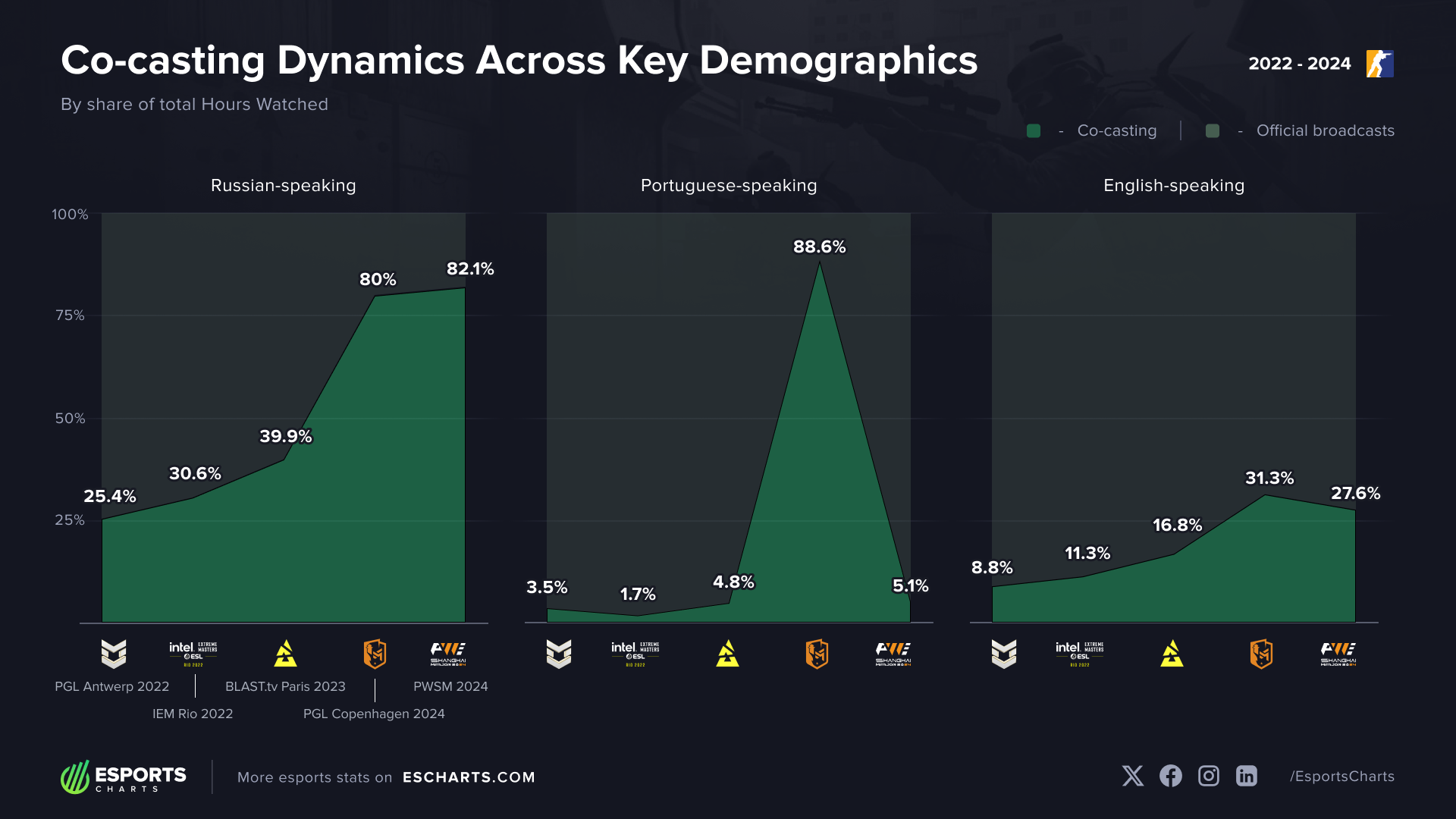
A closer look at co-streaming across the three key broadcast languages — English, Portuguese (including Brazilian Portuguese), and Russian — reveals just how dramatically the landscape has shifted. These languages collectively account for the vast majority of Counter-Strike’s global esports audience.
The Russian-language broadcasts are perhaps the most striking example. Just three years ago, co-streamers captured at best a quarter of the viewership. But in the two most recent Majors, where many Russian-speaking streamers held no-delay rights, the share of independent broadcasts skyrocketed to over 80%.
In the English-speaking market, official channels still dominate. Most viewers continue to prefer the organizer-produced studio streams, which generally meet audience expectations. Still, co-streaming has steadily gained ground here too: its share has grown from less than 10% to between 27% and 31% over the past few years.
The Portuguese-language case is particularly fascinating. Co-streaming usually plays only a minor role in this market, accounting for just 1-5% of viewership across most tournaments. But one event stood out dramatically: at the PGL Major Copenhagen 2024, co-streamers commanded a staggering 88.6% of the Portuguese-speaking audience. That’s the most extreme co-streaming skew recorded across any major demographic.
What caused such a dramatic shift? The answer is simple. For the first time in years, Alexandre "Gaules" Borba Chiqueta, Brazil’s beloved Counter-Strike icon, did not hold the exclusive no-delay streaming rights. Instead, the official broadcast was handled by BTS Brasil. As the numbers clearly show, fans overwhelmingly chose to stick with Gaules' channel even with a delay, underscoring the strength of creator loyalty in the region.

While English-speaking viewers are generally less inclined to watch Majors on unofficial streams compared to fans in Brazil or Eastern Europe, the single most influential Counter-Strike co-streamer is, in fact, an English-speaking creator: Mark "Ohnepixel" Zimmermann. Known for his massive reach within both the competitive CS community and the case-opening segment of fans, the German influencer has covered every recent Major, and collectively amassed over 13.3 million Hours Watched across them. That’s more than the official broadcasts of some studio-run channels.
In the Russian-speaking community, the leading co-streamer by audience is Ukrainian creator Vadim “Evelone” Kazakov, the most-subscribed Russian-language streamer on Twitch. While Counter-Strike isn’t his main focus, he frequently produces CS-related content, especially case openings and streamer-driven events, often featuring professional players.
Other notable figures include Erik "fl0m" Flom, a veteran CS streamer and former pro, as well as Igor “SL4M” Sopov, one of the most recognizable voices in Russian Counter-Strike broadcasting, known for his long-standing work with StarLadder.
***
Co-streaming has grown from a niche addition to official coverage into a central pillar of Major viewership, especially over the last few tournament cycles. In regions like Eastern Europe watching Majors through independent creators has already become the norm, driven by popular personalities, flexible formats, and the appeal of real-time, no-delay streams. Meanwhile, English-speaking audiences are gradually catching up, with co-streamers carving out a larger share of viewership year by year.
With the upcoming Austin Major taking place in the United States, all eyes will be on how the co-streaming dynamic plays out, particularly given the time zone challenges for European fans. Will North American creators rise to the occasion? Will Eastern European audiences stick with their favorite streamers despite the late hours? We’ll be tracking it closely, so stay tuned in the coming weeks as we share more insights, data deep-dives, and key storylines leading up to one of the most anticipated Counter-Strike events of the year.

Ayrıntılı Esports verileri parmaklarınızın ucunda.
Abone olmak & keşfetmeye başlayın!


