
How League of Legends Worlds viewership has evolved: co-casting explosion and official broadcasts stepping back
Since the beginning of the Worlds series for League of Legends in 2016, viewership for the tournament has consistently grown and pushed the boundaries of esports broadcasting. While the event’s viewership previously came almost entirely from official broadcasts, this has shifted since the integration of co-casters in 2023. Esports Charts highlights how official viewership for the Worlds series has evolved, particularly in the past couple of years.
From Worlds’ 2016 edition all the way to 2021, viewership climbed for the series year-on-year. The last year of this constant growth benefitted from being hosted during the pandemic, when the esports broadcasting and livestreaming industries both enjoyed massive growths in viewership. Worlds 2021 recorded the second-highest average viewership of any Worlds event, falling only behind the ongoing Worlds 2024, which has had its overall watch time curtailed by a drop in broadcasting time.
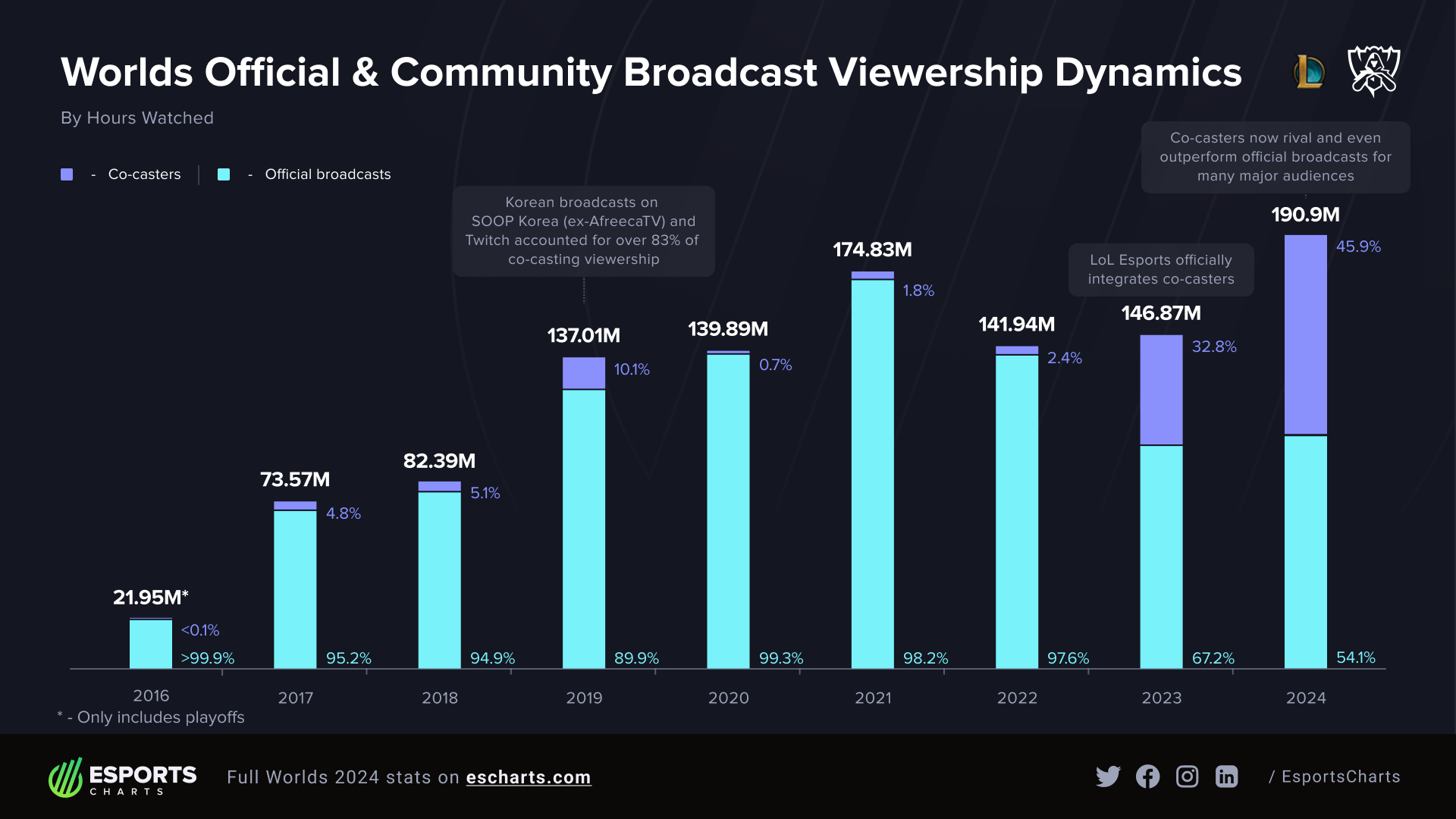
2019 stood out from the other earlier years, with 10% of its 137.01M Hours Watched coming from co-casters. This co-casting viewership almost entirely represents Korean audiences, who supported community casters on both Twitch and SOOP Korea (which was known as AfreecaTV at the time). Excluding 2019, no other Worlds event before 2023 benefitted from sizable co-casting viewership.
Heading into Worlds 2023, Riot Games revitalised the co-casting scene, naming official co-streaming partners and selecting some of the most popular global League of Legends esports streamers. While this new wave of co-casters has helped the event continue to increase its viewership in a post-pandemic landscape, it has visibly negatively affected the viewership of official broadcasts. Interestingly, this negative effect was regionally-based and did not affect all the major audiences for Worlds.
For example, 2023 saw viewership for select Asian audiences rise significantly, whereas European languages suffered and recorded significant drops in overall viewership, with these new co-casters seemingly destabilising Worlds viewership. We will delve into this topic later when we turn our attention to year-on-year dynamics and trends for the past few years.
Although Worlds 2024 still hasn’t held its grand final match, it has already cemented itself as one of the most-watched iterations of the event. Co-casting for the series has grown significantly in 2024 and now makes up almost half of the event’s total viewership. Official broadcast viewership continues to fall, but the previously negatively affected European languages have recovered, and are recording viewership on par with their previous 2022 heights.

The official English-language riotgames Twitch channel has been consistently the most-watched broadcasting option for League of Legends fans at Worlds. As the forerunner of official broadcasts, this channel is an ideal candidate to view how significantly the new co-casting system has affected these official streams.
While the riotgames channel recorded year-on-year increases in viewership every year before 2023, the emergence of co-casters has significantly reduced this channel’s popularity. When co-casting was integrated into Worlds broadcasting in 2023, viewership for the riotgames channel fell by 56%; although Worlds 2024 is not over yet, it is extremely likely 2024 will record another drop in viewership for this channel.
The official YouTube broadcasts, such as LoL Esports, were not as drastically affected as their Twitch counterparts. Viewership for this official English broadcast on YouTube has generally plateaued since 2020, and 2023 saw the channel reach an impressive peak viewership, but record low watch time for the event overall.
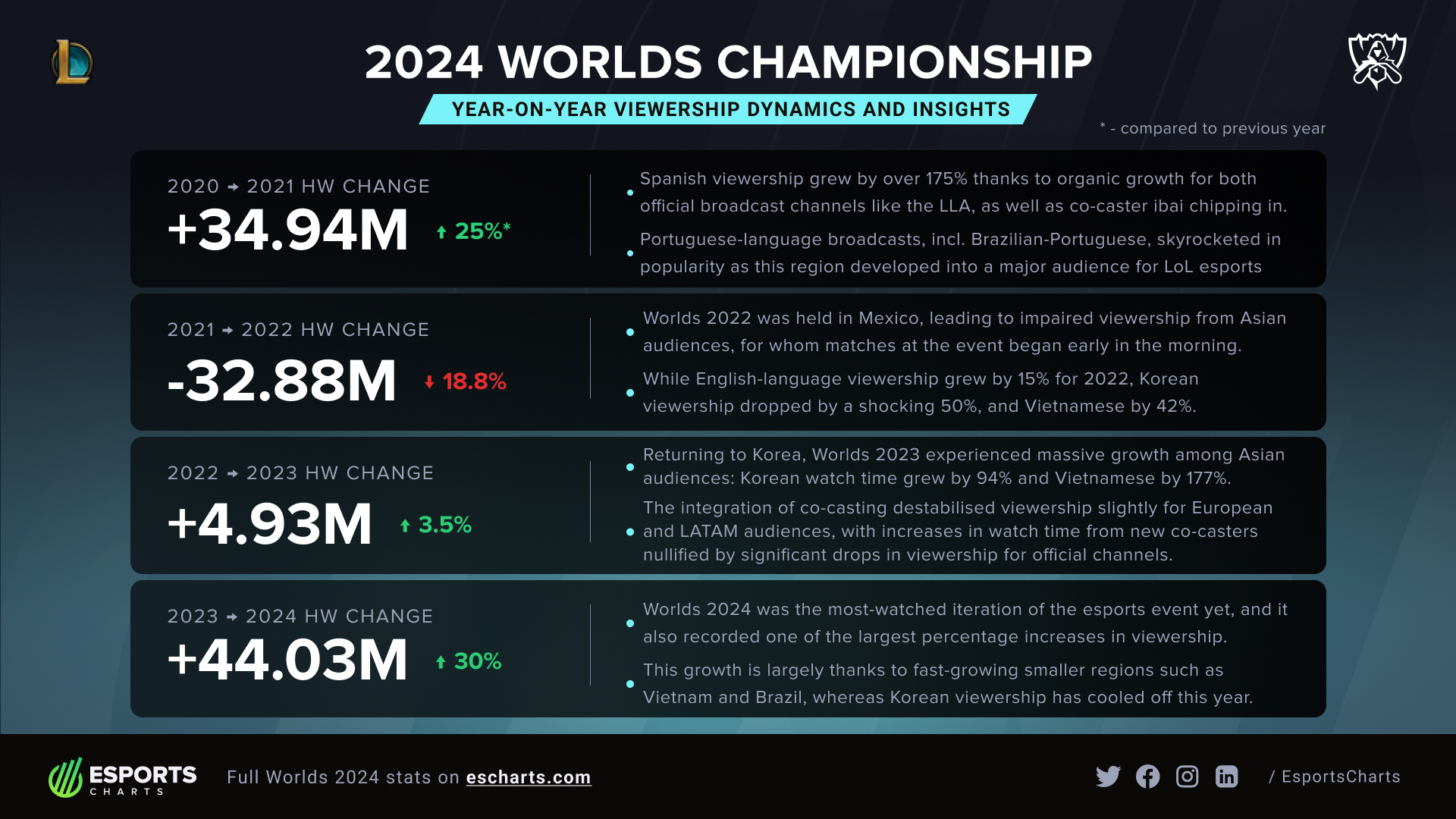
If we take a closer look at Worlds’ most recent years in more detail, 2021 was massively popular thanks to growing regional audiences, who were also able to support Wolrds more heavily thanks to lockdowns. Spanish and Portuguese-speaking, mainly Brazilian, audiences grew significantly in 2021, with Spanish streams recording a 175%+ increase in watch time.
Viewership for Worlds 2022 fell by 18.8% compared to the previous year, largely due to two reasons. Firstly, the pandemic boost for esports broadcasting was wearing off, and viewership was bound to fall compared to the highly-watched 2021 edition. Secondly, the tournament was held in Mexico, with matches beginning before the sun rose in some Asian countries. Although 2022 saw strong viewership from European languages, Korean viewership was halved compared to 2021, and other strong Asian audiences like Vietnamese suffered too.
Considering what we have looked at so far, there are some crucial keys to Worlds’ ever-changing viewership. While co-casting may help LoL esports in the long-term, it has majorly affected the viewership for official broadcasts and could mean sponsors may have to recalibrate their understanding of Worlds’ viewership. The location and scheduling of the event is also key, with Worlds 2022 emerging as a cautionary tale against excluding popular Asian regions.
Even before the Worlds 2024 grand final, viewership for the event has already grown by over 10% compared to 2023. The tournament’s growth has been fuelled by Vietnamese and Brazilian viewers, who represent two of the game’s fastest-growing fanbases. Other historically popular languages like Korean have not been as lucky this year, although this audience could still reach millions of concurrent viewers to support their countrymen, T1, in the grand final.
The grand final of Worlds 2024 begins on Saturday, November 2, at 14:00 GMT. The event could well be one of the most popular Worlds ever, and before the final begins, Esports Charts will present our review of which factors could influence viewership. From historical viewership growth for finals to the potential of language demographics, we will present all sides to League of Legends esports viewership.

Ayrıntılı Esports verileri parmaklarınızın ucunda.
Abone olmak & keşfetmeye başlayın!


