
When people talk about emerging regions in the esports world, places like South America or Southeast Asia usually come to mind, areas where the local scenes and broader industries are gradually catching up with more established markets. But there’s another region quietly gaining ground on the global stage: Central Asia.
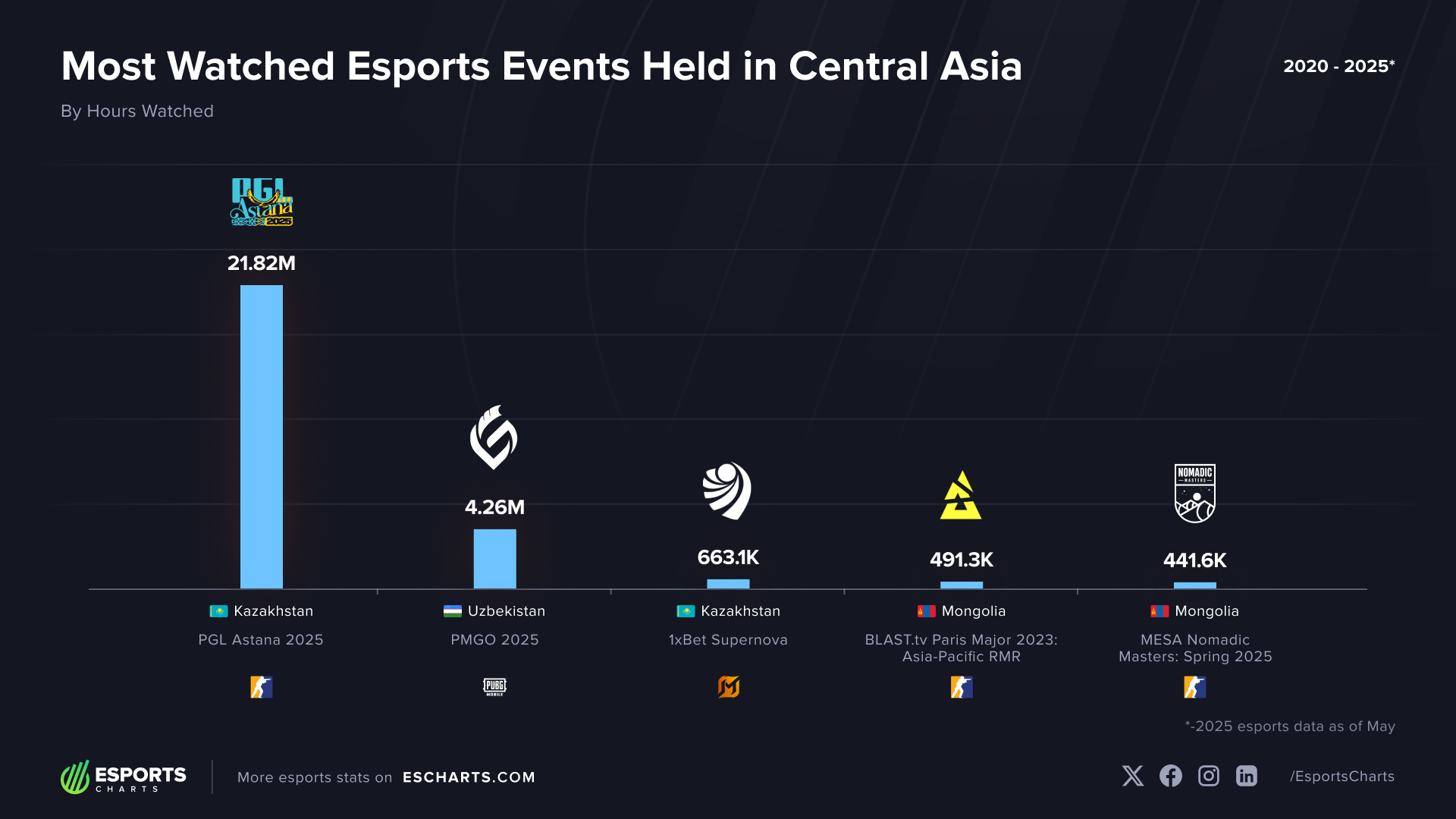
Recently, Kazakhstan played host to the biggest esports event in the region’s history: PGL Astana 2025, a major Counter-Strike tournament. The event wasn’t just a hit online, drawing impressive viewership numbers, it also made a powerful impact offline. The local crowd delivered such passionate engagement that many in the industry have started seeing Kazakhstan as a strong candidate to regularly host top-tier events going forward.
And while PGL Astana was the standout moment, it wasn’t the only sign of the region’s rise. Countries across Central Asia have already hosted major tournaments in other games, and the Mongolian team The MongolZ has become a breakout success in Counter-Strike. Not only do they consistently pull strong online numbers, but they’ve also proven to be a stable and exciting presence in one of the world’s most competitive esports scenes.
The Esports Charts team has gathered key statistics to highlight how viewership is growing across Central Asia, which games dominate the local scene, who the key tournament organizers are, and what might come next for this fast-evolving region.
From the start: How Kazakhstan shaped Central Asian esports in the 2000s
The world may only now be paying serious attention to Central Asia’s esports scene, but the region has been making waves locally since the early 2000s, and largely thanks to Kazakhstan. Back then, a handful of dedicated esports patrons helped launch the careers of players and teams that would go on to become legends, including the now world-renowned Natus Vincere.
One figure, in particular, stands out: Murat Zhumashevich, better known in the esports world as Arbalet. He was a pioneer, a key sponsor behind a series of tournaments that carried his name and offered impressive prize pools for their time. From Unreal Tournament and StarCraft to the iconic Counter-Strike 1.6 and original DotA, Arbalet helped elevate multiple games and countless players.
It was Arbalet who backed the first-ever Counter-Strike lineup of Natus Vincere, the same roster that made history in 2010 by sweeping the three biggest tournaments of the year, the de facto Majors of the era. Watch footage from those events and you’ll spot players across the post-Soviet space adding “/A/” to their nicknames, a humble tribute to a man who avoided the spotlight but left a massive mark on the region’s esports legacy.
Did you know?
One of the teams that climbed the esports ladder thanks to the Arbalet Cup was Kazakhstan’s k23, the first local squad to make a real impact on the global Counter-Strike scene. In 2005, the team, which included future CS:GO Major champion Däuren "AdreN" Qystaubaev, finished second at the World Cyber Games, one of the most prestigious tournaments of the time. Over the years, k23 became a regular fixture in regional finals, racking up multiple titles and earning more than $100,000 during its relatively short run, a remarkable figure for the 2000s.
But Arbalet wasn’t alone. In the late 2000s and early 2010s, Kazakhstan saw the rise of other influential players, particularly in tournament organization. One standout was the Omega Sector Professional League (OSPL), a major circuit run by a popular chain of gaming cafes. OSPL hosted competitions across a wide range of titles, with a special focus on DotA.
Around the same time, the NEXT.kz network emerged as a key rival. Not only did they host regional qualifiers for the World Cyber Games and TechLabs, they also fielded their own esports rosters (especially in CS and DotA), becoming a major force in the local competitive scene.
Despite the popularity and recognition these efforts gained in Kazakhstan and across the CIS, they didn’t quite break through to the global stage. That spotlight would only come later, earned by the next generation that built on their legacy.
How has Central Asia's esports scene evolved in recent years?
It’s no exaggeration to say that the growth of the Central Asian esports scene in recent years has largely been shaped by two countries: Kazakhstan and Mongolia. Both have long been Counter-Strike strongholds, producing players and teams that have earned international respect. Kazakhstan even boasts Major-winning talent: just think of Gambit Esports, who claimed a CS:GO Major title with three Kazakhstani players in the lineup. It’s also worth mentioning the StarLadder Berlin Major 2019 runners-up, AVANGAR. Some members of that lineup would later go on to win the IEM Rio Major 2022, this time under the Outsiders banner.
Mongolia, while only recently gaining global attention, has had its own standout moments. For example, back in 2015, Enkhtaivan "Machinegun" Lkhagva of The MongolZ made headlines by securing a move to North America after drawing international interest.
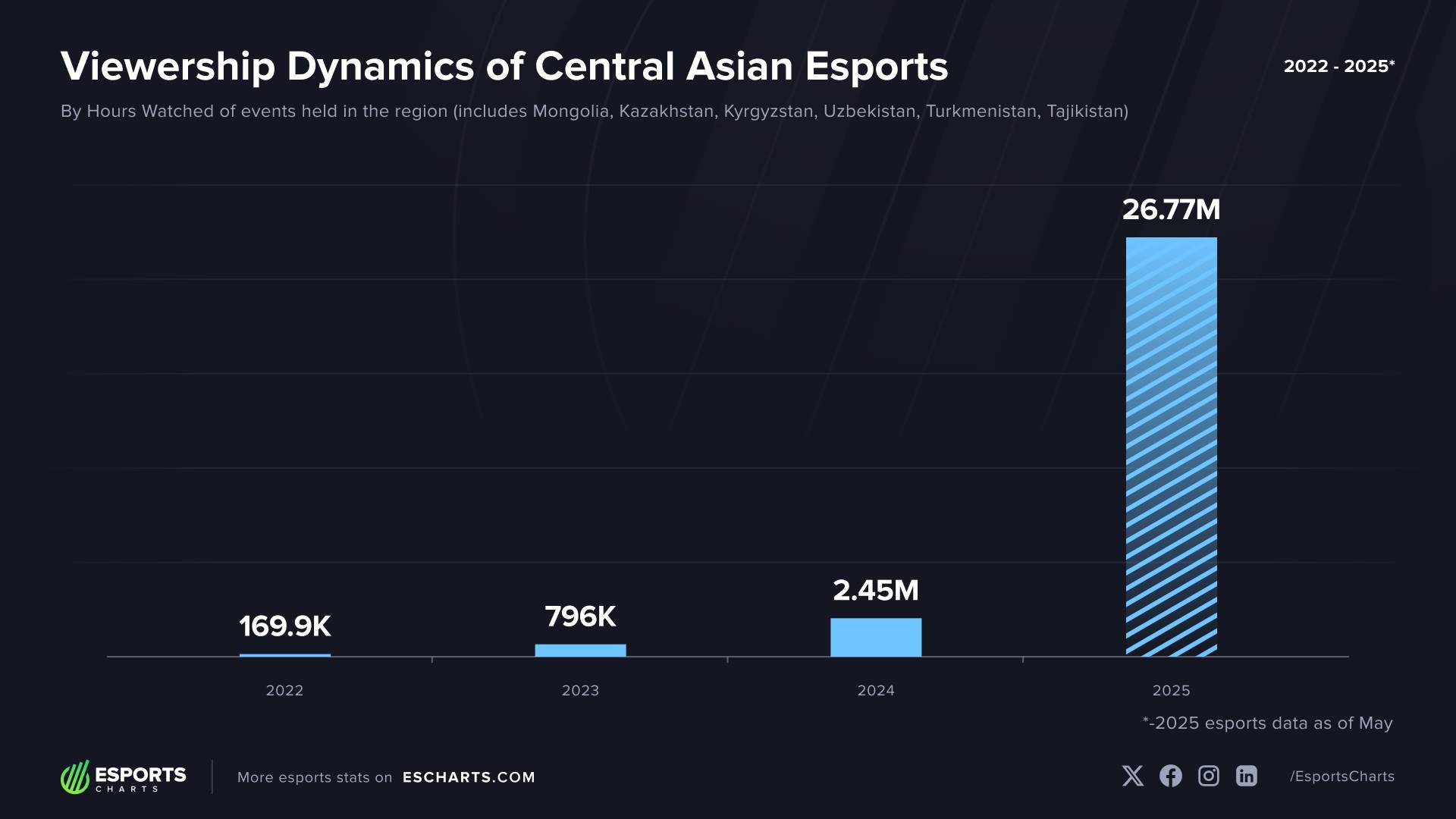
Beyond PC titles, mobile esports has also gained serious traction in both nations. Between 2020 and 2023, local organizers such as Pinger.pro and the national esports federations, QCF in Kazakhstan and MESA in Mongolia, held well-attended events in games like PUBG Mobile and Free Fire, attracting solid regional viewership.
The turning point came around 2023-2024, as Central Asia began hosting qualifiers for major international tournaments, most notably within the BLAST Premier Counter-Strike circuit as well as major CIS Mobile Legends: Bang Bang league, MCC.
Around the same time, Uzbekistan emerged as a new player on the scene too, with PUBG Mobile organizers introducing high-profile events such as the Global Open and National Championship in the country.
Did you know?
2023 marked a historic breakthrough for Mongolian esports, as not one but two local rosters reached the pinnacle of global competition. IHC ESPORTS delivered a landmark victory at the PUBG Mobile Global Championship, securing the championship title and a share of the tournament’s $3 million prize pool. Remarkably, the runner-up position also went to a Mongolian squad, competing under the banner of Indian organization Stalwart Esports, making it a double triumph for the country. It was a defining moment that firmly established Mongolia as a rising powerhouse in the global mobile esports scene.

2025 marked a true breakthrough. That year, Central Asia hosted its first esports event to surpass 1 million hours watched: the PUBG Mobile Global Open 2025, an S-tier tournament in one of the world’s biggest mobile esports titles. And while the title didn’t go to a local squad, the region made a strong statement: Uzbekistan’s THE721 AGGRESSOR secured an impressive third-place finish, while Mongolian star Uuganbayar "DOK" Dulguun from 4Merical Vibes was named the tournament’s MVP.
The MongolZ: Central Asia’s breakout team in top-tier esports
Ask any average esports fan what they know about Central Asia, and chances are The MongolZ will be the first name you hear. While the team’s tag dates back to 2013, their true breakthrough came after a relaunch, with 2024 marking a milestone year. That season, the team clinched several high-profile tournament victories against world-class opponents, and, most notably, became the first Mongolian team to reach the playoffs of a CS Major, a landmark moment for the region.

Even before their resurgence, The MongolZ had made waves internationally. In the mid-2010s, they secured solid results at major events such as ESL One and Intel Extreme Masters. One standout moment came when they won IEM Taipei, defeating a strong Renegades lineup in the grand final.
But their impact goes well beyond the server. In recent years, The MongolZ has not only helped popularize esports in Mongolia: they’ve also become a source of national pride. Their success has been recognized at the highest level, with the team receiving official support from the Mongolian government, including national athlete status and financial backing for international competition.
Today, their matches draw tens of thousands of concurrent viewers on Mongolian-language streams, something that would have seemed unrealistic just a few years ago. In 2024, esports content in Mongolian surpassed 7.4 million Hours Watched, with the lion’s share attributed to Counter-Strike and The MongolZ in particular.
What’s truly remarkable is the scale of engagement: the current concurrent viewership peak for Mongolian esports stands at over 73,000. For a country of just 3.4 million people, that means roughly 2% of the entire population tuned in live, a proportion that far exceeds the esports share of viewership in countries like France, Germany, or even Indonesia, where millions follow titles like MLBB. It’s not just impressive, it’s nearly unprecedented.
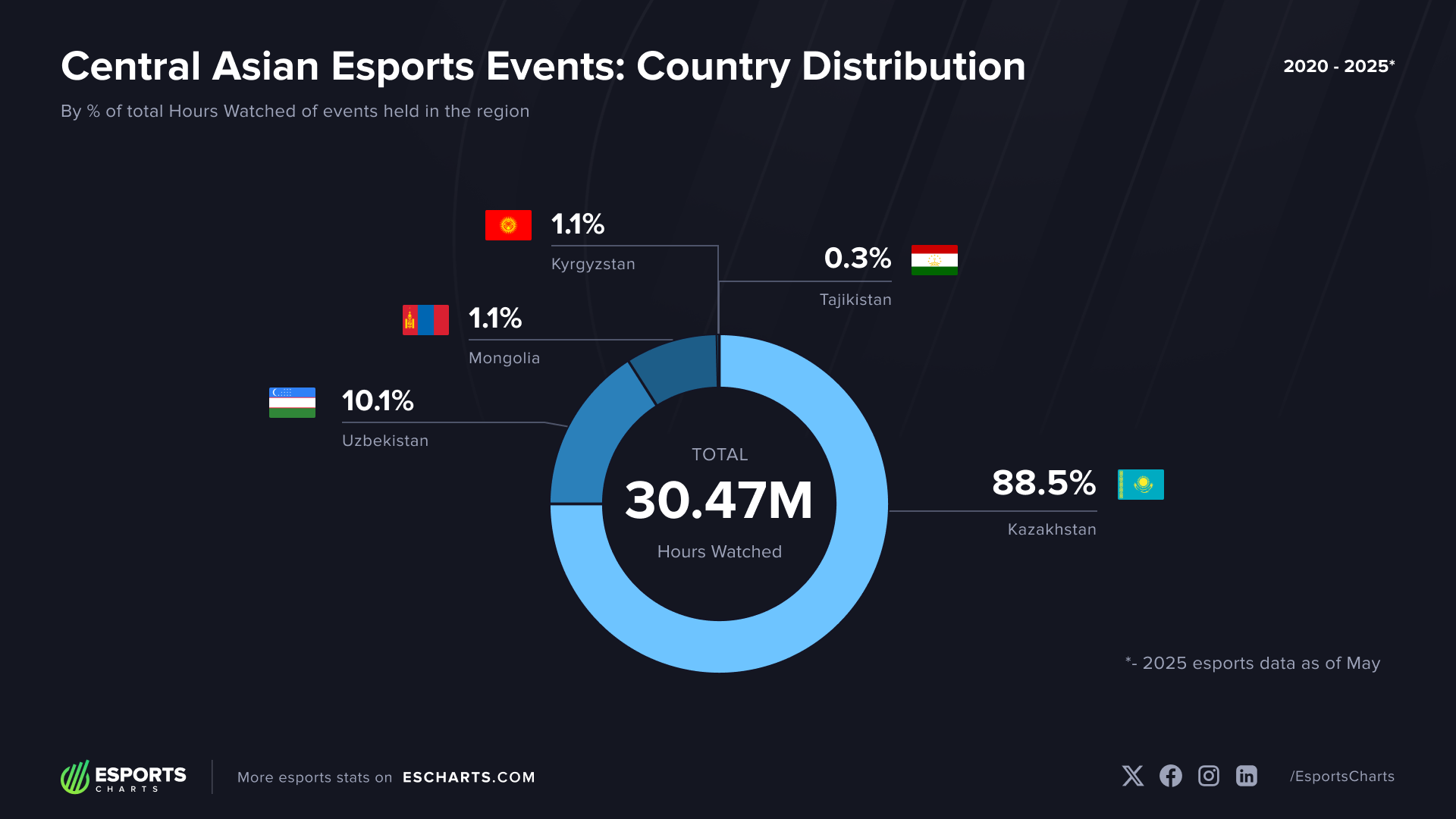
Among Central Asian countries, Mongolia now leads in terms of regional esports engagement. While Kazakh and Uzbek audiences are also showing promising growth, they still trail far behind Mongolia’s numbers.
***
What’s happening in Central Asia right now isn’t just a fleeting moment of hype, it’s the foundation of something much bigger. The region has already proven its ability to produce world-class talent, rally passionate fanbases, and host high-level competitions. The speed of this transformation is striking, driven not only by standout teams like The MongolZ but also by the growing professionalism of local tournament organizers and federations.
Of course, challenges remain. The region’s geographic remoteness creates logistical hurdles, many Central Asian countries still lack direct transport and digital infrastructure links to key esports hubs in Europe and North America. This complicates participation in international events and limits access to broader sponsorship and media opportunities.
But even these barriers are beginning to erode. With a strong cultural affinity for competitive gaming, rising government support, and a fast-growing digital audience, Central Asia is steadily carving out its place on the global esports map. The foundations are already in place, and if recent momentum is any indication, the region is poised not just to participate in global esports, but to help shape its future. The next breakout star or headline-grabbing event could well come from here.

Detailed Esports data at your fingertips.
Subscribe to & start exploring!


