

The International viewership retrospective: Is the Dota 2 series fading away?
In just a few weeks, the Dota 2 world will turn its eyes once again to The International, the legendary tournament that has for years stood as the pinnacle of esports competition. More than just a marquee event for Dota 2, The International has historically set the standard for viewership, prize pools and global attention across the entire esports landscape. However, the current state of the tournament is far from as bright as it was just a few years ago.
At its peak, the series reached unprecedented heights, captivating millions of fans and elevating competitive gaming to new levels of mainstream recognition. Since then, both audience numbers and broader engagement have shown a slow, steady decline.
Is the series approaching a dead end, or has it simply found a plateau after years of explosive growth? In this retrospective, we break down the viewership dynamics of The International and explore what its trajectory might mean for the future of the series.
On the road to record-breaking viewership
For the first decade of its existence, The International wasn’t just another tournament; it was a trendsetter. The event helped define what a developer-backed esports championship could look like, inspiring other games to launch their own high-profile (global) competitions and contributing to the rapid growth of prize pools across the industry. Year after year, the scale, stakes and audience engagement of The International expanded.
The year 2020 marked a turning point. For the first time, The International was canceled due to COVID-19 restrictions, and competitive Dota 2, like much of esports, had been confined almost entirely to online tournaments.
Yet the absence of the event didn’t dampen fan enthusiasm. On the contrary, anticipation for the 2021 edition reached a fever pitch. That tournament became a milestone in every sense: it set records for prize money, global engagement, and viewership, with over 2.74 million concurrent live viewers tuning in.
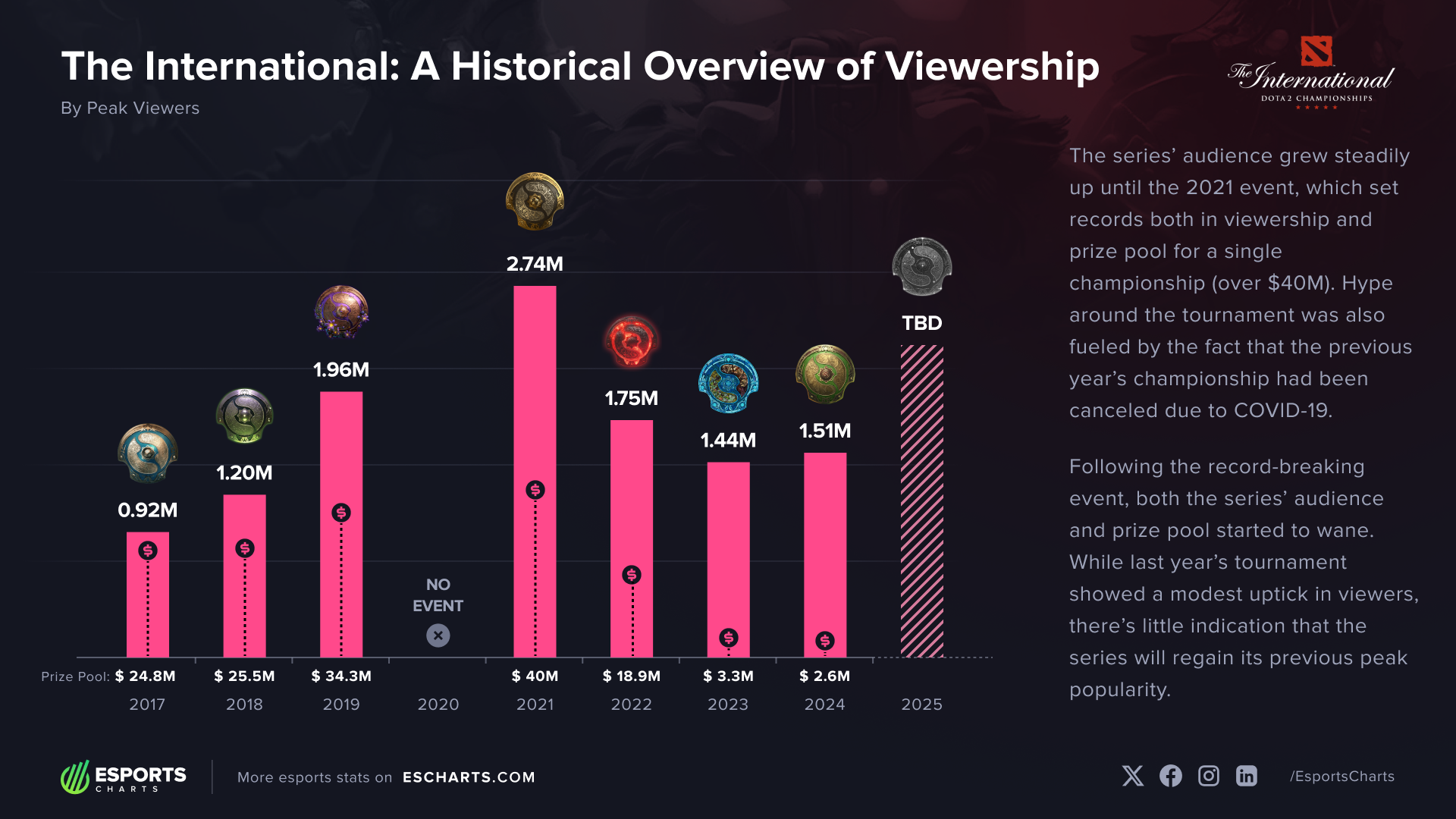
Much of the hype was fueled by the grand final, which featured a showdown between China’s PSG.LGD and Russia’s Team Spirit, a dramatic Asia vs. Europe clash. The matchup ignited particularly strong interest among Russian-speaking fans, who were energized by seeing their team compete for the Aegis in the finals for the first time since 2013. The combination of record-breaking stakes, global attention and compelling narratives made TI 2021 a defining moment for both the series and Dota 2 esports as a whole.
What direction is the series taking today?
2021 became a defining moment for the competitive Dota scene. The forced break in the series, a finals matchup resonating with a large audience, and a convenient European timezone for the core Dota audience: all of this played in favor of the event. Since then, the scene has steadily declined, not just within esports itself, but in the game overall.
Part of the decline comes from the competitive structure. The proliferation of Tier 1 events after Valve scaled back the DPC created a grueling schedule for teams, contributing to burnout and inconsistent lineups. At the same time, regional leagues suffered falling viewership, weaker rosters and high-profile scandals, leaving both fans and organizations frustrated.
Meanwhile, competing esports titles and more accessible games have drawn players and attention away from Dota 2, leaving the scene more fragmented than ever. Today, the game remains primarily relevant in Western Europe, Southeast Asia, and Russia.
Beyond the broader issues affecting Dota 2, The International itself has suffered. Prize pools no longer break records, players are spending less on the title, in part because recent Battle Passes for TI have offered less content that resonates with the community. Overall spending on TI has clearly declined, as noted by both players and team representatives.
Even the iconic True Sight documentary series has been discontinued. As Dmitry “Korb3n” Belov, manager of two-time world champions Team Spirit, put it: “The only thing left of The International is the Aegis”.
Amid the upheaval in the competitive cycle (Valve no longer runs a structured tournament system on its own, leaving the season dominated by multiple third-party events), The International’s audience engagement has slipped back to pre-2019 levels. Even though the 2024 edition slightly improved its peak viewership compared to 2023, the overall trend is clear: TI is facing challenging times. Efforts to strengthen Dota’s competitive scene alone won’t be enough to return the series to a growth trajectory; a broader rethinking of Valve’s approach to the game as a whole is needed.

Detailed Esports data at your fingertips.
Subscribe to & start exploring!


