Low-budget sometimes yields higher rewards: how esports broadcasters fill downtime on air
Part of any esports event broadcast is downtime between games. Esports matches are hard to calculate duration for: sometimes games end in just over half an hour, with others sometimes taking multiple hours due to in-game overtime and close stalemates. Broadcasters have taken different approaches to filling this non-gaming time, and Esports Charts have observed clear differences in viewership statistics, depending on how organizers fill these intermissions.
Esports Charts has tracked gaming and non-gaming viewership for countless esports tournaments. These viewership statistics reflect how much of their total broadcasting time and watch time came from their broadcast of matches, compared to the same statistics for non-gaming content between matches. With this data in hand, we can compare different broadcasting approaches of event organizers, and even examine some highlights of non-gaming content in esports.
Any esports fan will be well-used to the simple countdown. Many events, especially those hosted online rather than in-person at an offline LAN tournament, suffer from long breaks between matches. While at a LAN event the event organizers can alert teams to schedule changes and these teams can be ready to play given notice, organizing players at an online event is a different beast.
Many events, both offline and online, resort to a simple countdown to fill these intermissions: fans are alerted when the action begins again, but this leads to many fans tuning away from the broadcast during the intermission.

In mobile gaming, Mobile Legends: Bang Bang is an industry-leader and is overall one of the most popular esports titles in the whole world. The MPL is the top-tier of circuit competition for the title, and it hosts local offline leagues for MLBB’s most popular regions. Although these events are run offline, the organizers stick to their schedule, with the broadcast hosting countdown-centered breaks between matches. This may be done for the sake of those viewing the event in-person, giving these fans a time to step outside the arena and have something to eat.
Despite these events being some of the most-watched esports tournaments in the esports sphere, their watch time for breaks between matches is abysmally low. This is not particularly surprising; with often times nothing on the broadcast but a simple countdown until the next match, fans are not encouraged to remain watching. While the MPL is already massively popular, it does leave some potential unfulfilled, considering how long these breaks can be.
Take the MPL Indonesia Season 14 for example. This Indonesian tournament saw over 20% of its total broadcasting time dedicated to breaks between matches, but these breaks only accounted for 5.1% of the tournament’s total watch time. Those 47 hours of broadcasting time between matches are an opportunity for the MPL to garner further watch time through more engaging activities, rather than leaving a simple countdown on broadcast.
What are the alternatives to leaving a timer on broadcast? Well, many esports event organizers attempt to fill the gaps between matches with various forms of content, but it is important that these organizers understand their fanbase. Some of the highest-production events in esports suffer from low viewership for their non-gaming content, due to fans largely only being interested in the matches themselves.
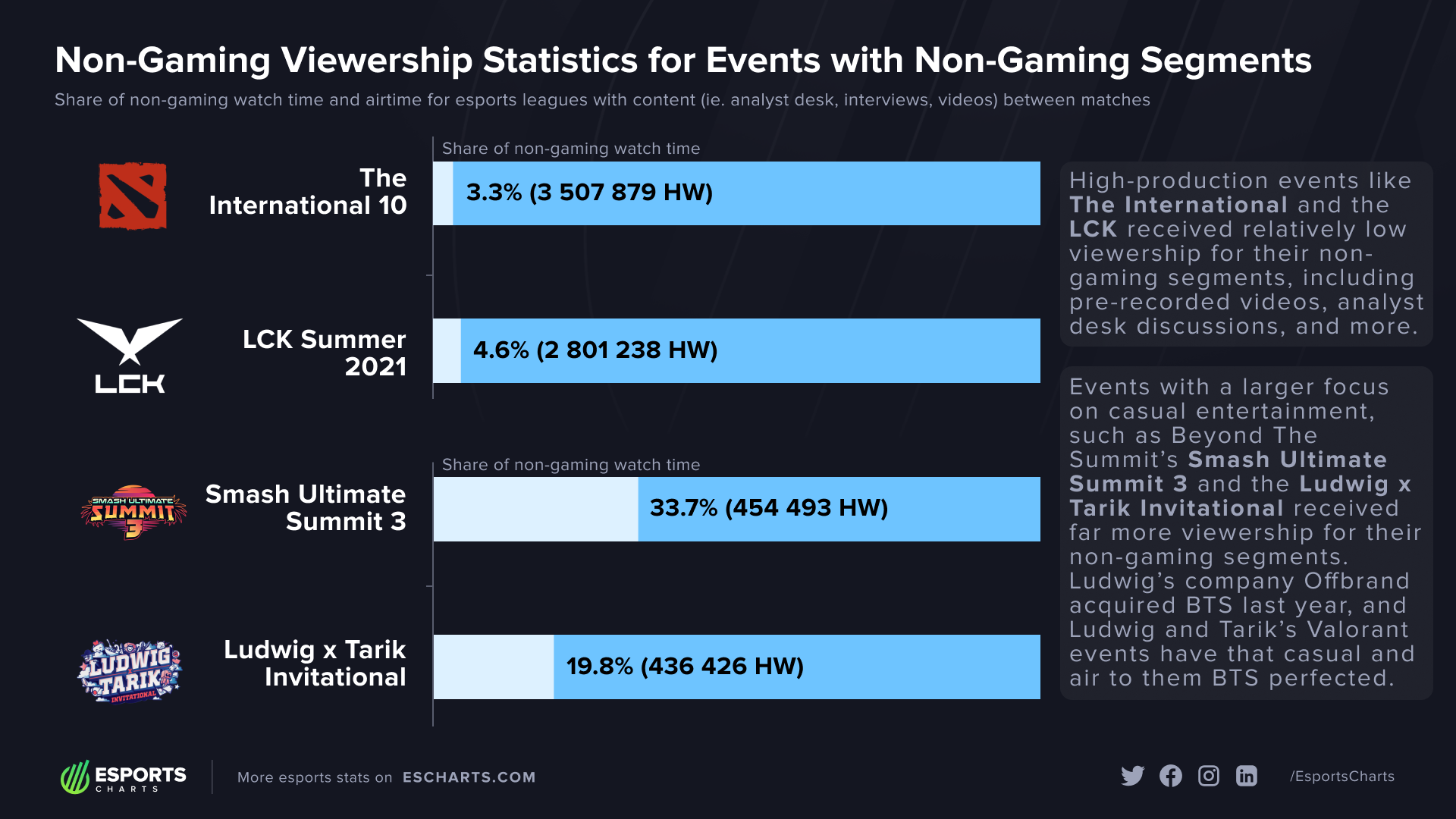
The International 10 and the LCK Summer 2021 are two examples of high-production esports events which still received low watch time for content between matches, despite making an effort. The International 10 received only 3.3% of its total watch time from non-gaming content, significantly less than other tournaments which simply put a timer until the next match on stream.
Similar to other season-ending events in esports, The International 10’s non-gaming segments were made up of team introduction videos, analyst desk analysis, post-match interviews, and more. The official broadcast for the event was live for up to almost 12 hours daily, and the raw amount of content and non-gaming segments between games was significant.
On the other hand, the LCK Summer 2021 had much shorter delays between matches. The tournament usually hosts two matches a day during the regular season, and the broadcasters just have to fill up this short break between the two games. Although the LCK broadcasts begin with a countdown, once the broadcast starts, it runs all the way until the end, with no broadcast breaks between matches.
The International 10 and LCK Summer 2021 both take a serious approach to non-gaming segments. Broadcasters remain professional, and the content is centred around the competitive matches, whether this be team introductions and predictions before the match, or post-game discussions and interviews afterwards. These expensive high-production broadcasts performed significantly worse in terms of proportional watch time of non-gaming segments compared to more casual events, like the Smash Ultimate Summit 3 and Ludwig x Tarik Invitational.
Former event organizers and production house Beyond the Summit are well-known in esports for their casual content between matches. Commentary of games was hosted from a simple couch, with guest stars making appearances to excite fans. This simple and casual approach to esports was something BTS were wildly celebrated for, and something Ludwig and Tarik were inspired by.
#UltimateSummit 3 is JUST around the corner ?
— Beyond the Smash (@BTSsmash) August 24, 2021
We have four days of fun ahead of us, and here's when everything is going down!
See you Thursday at 10AM PDT ??️
? https://t.co/gTvtiwXfa6 pic.twitter.com/XznyL1btO2
Smash Ultimate Summit 3’s schedule was full of community events and casual content
Ludwig, as a former Smash player, knows BTS’ style of production well. He and Tarik brought BTS on to work behind the cameras at their first Ludwig x Tarik Invitational. The commentary for matches came from a cosy couch set-up, and many popular commentators, coaches, and Valorant personalities appeared on the broadcast to support the event. In fact, once BTS announced their shut-down in 2023, Ludwig quickly acquired the production team to join his Offbrand Productions team.
The Smash Ultimate Summit 3 is a perfect example of how casual content featuring players and personalities can incite high viewership. The tournament received over a third of its total watch time from non-gaming segments, and many professionals attending the event participated in party games and other challenges on stream. The first Ludwig x Tarik Invitational was not as wild as the Smash event: it still hosted a similar cosy and laid-back feel, although the community events featuring players were toned down.
While Smash Ultimate Summit 3 generated its non-gaming segment watch time from players and Smash personalities appearing on broadcast, the Ludwig x Tarik Invitational focused more on the two massive content creators behind the event, with both of them drafting teams on-stream for a live showmatch against each other. While both of these tournaments achieved far less watch time than the world-famous The International and LCK series, their approach to generating viewership between matches helped these events to maximise their potential.
Showmatches and other special events are a fundamental option for esports broadcasters to fill the gap between matches with something to excite fans. In fact, some of the most popular showmatches and special events in esports have generated millions of watch time on their own; Esports Charts presents a selection of some of the most-watched non-gaming special events in esports.

At the Fortnite World Cup 2019 Finals, the organizers held a Creative Cup, involving 8 teams led by popular Fortnite content creators and personalities. The tournament featured an eclectic assortment of former professionals, many of whom have since transitioned into full-time content creation. The list included America’s Cizzorz and Ninja, Tomoya from Japan, and many popular regional streamers from Europe like Gotaga, Rubius, and HandofBlood.
All in all, this Creative Cup at the World Cup 2019 received 3.8M Hours Watched, making it one of the most-watched showmatches ever hosted in esports. The viewership for this event was boosted by the fact the involved creators appealed to so many sizable international audiences, as well as the timing of the event coming during Fortnite’s peak of cultural relevance.
Generally, all the other selected showmatches here also appealed to various international audiences through retired players and personalities, but not to the extent Fortnite managed. The showmatch at the PGL Major Stockholm 2021 for Counter-Strike was a rare one, as it was the only one in our selection here to feature an actual proper team.
At the event, retired but legendary Swedes GeT_RiGhT, Olofmeister, and Fifflaren came together with fan-favourites Zeus and YEKINDAR to play against the Copenhagen Flames, who at the time were ranked #10 in the world by HLTV. As we have covered earlier, casual non-gaming content is generally more popular than competitive-oriented segments, and this Counter-Strike showmatch received proportionally lower viewership than the VCT 2023 LOCK//IN showmatch, compared to the events’ total viewership.
While many Counter-Strike fans may have been excited to see how these legendary players performed against an established team like Copenhagen Flames, utilizing content creators from various corners of the world would have likely resulted in a higher overall viewership for the Major’s showmatch.

Opening Ceremonies at esports events are largely separated between two factions, those which hosted their opening ceremony on the first day of the event, and those which held out until the grand finals, with it being more of a Finals Opening Ceremony. The Free Fire World Series 2021 Singapore and Worlds 2024 both held their opening ceremonies right before the finals of the tournament, which helped these events to benefit from the massive amount of viewers tuning in for the ultimate match.
Worlds 2024 also brought on various music acts to perform and attract viewers for their ceremony. This included rock and nu metal band Linkin Park, American singer/rapper Ashnikko, and others. The FFWS 2021 Singapore did not feature any musical acts, but rather an elaborate drone show to excite fans.
On the other hand, the FNCS 2024 Global Championship and Overwatch Champions Series 2024 Major all hosted their ceremonies on the opening day of the event. While these ceremonies were still able to generate considerable watch time, they would have likely achieved more on the final day. The odd one out here is the M5 World Championship, one of esports’ most-watched tournaments ever, which hosted an opening ceremony to surprisingly low viewers.
The M5 held its opening ceremony hours before the finals began, and it reached its peak viewership of 940.5K concurrent viewers right before its conclusion. If the M5 had pushed its opening ceremony back, like Worlds 2024 where the ceremony started only 30 minutes before the final game, it likely would have reached much higher viewership. In summary, timing an event’s special events with other critical official matches is key to achieving a high viewership.
In general, formal non-gaming segments at esports events are unlikely to draw high viewership. Although these segments often make up a significant portion of the total broadcasting time at an event, they were sometimes less-watched than other broadcasts, which leave a simple countdown on screen. Offering a more casual atmosphere involving players, personalities, and talent in on-broadcast events is far more likely to keep fans interested, and maximise the viewership potential of an event.
Detailed Esports data at your fingertips.
Subscribe to & start exploring!
Mentioned events