
Summer Showdown — the third tournament cycle of the Overwatch League 2021 wrapped up last Sunday and that means we can take a look at its viewership results to see how the event performed in comparison with previous major events of the OWL 2021 season.
Following May Melee and June Joust, the Summer Showdown took place over the last three weeks as a mostly online tournament. The exception was Week 13, when the East region matches were played at the Shanghai Dragons homestand. The China-based teams were competing on location, while the Korea-based teams played these matches remotely. The same was the case for the regional knockout stage in the East region.

As for the West region, the Dallas Fuel played their opening match of Week 13 against the Houston Outlaws in front of an audience at Esports Stadium Arlington. Although the match was online, it was the first OWL match in the West region, which includes North America and Europe, where at least one team has had a live audience since March 2020.
The fierce competition featured 24 teams battling for a share of the $225,000 prize pool, with the top four teams making it to the global double-elimination playoffs. The spotlight was focused mainly on the season-defining rivalry between the Shanghai Dragons and the Dallas Fuel. In the end, the Shanghai Dragons won their second major of this season with a 4-1 triumph over the Chengdu Hunters.
When it comes to viewership, however, the collected data show a slight underperformance of OWL 2021 Summer Showdown when compared to the league's previous cycles.
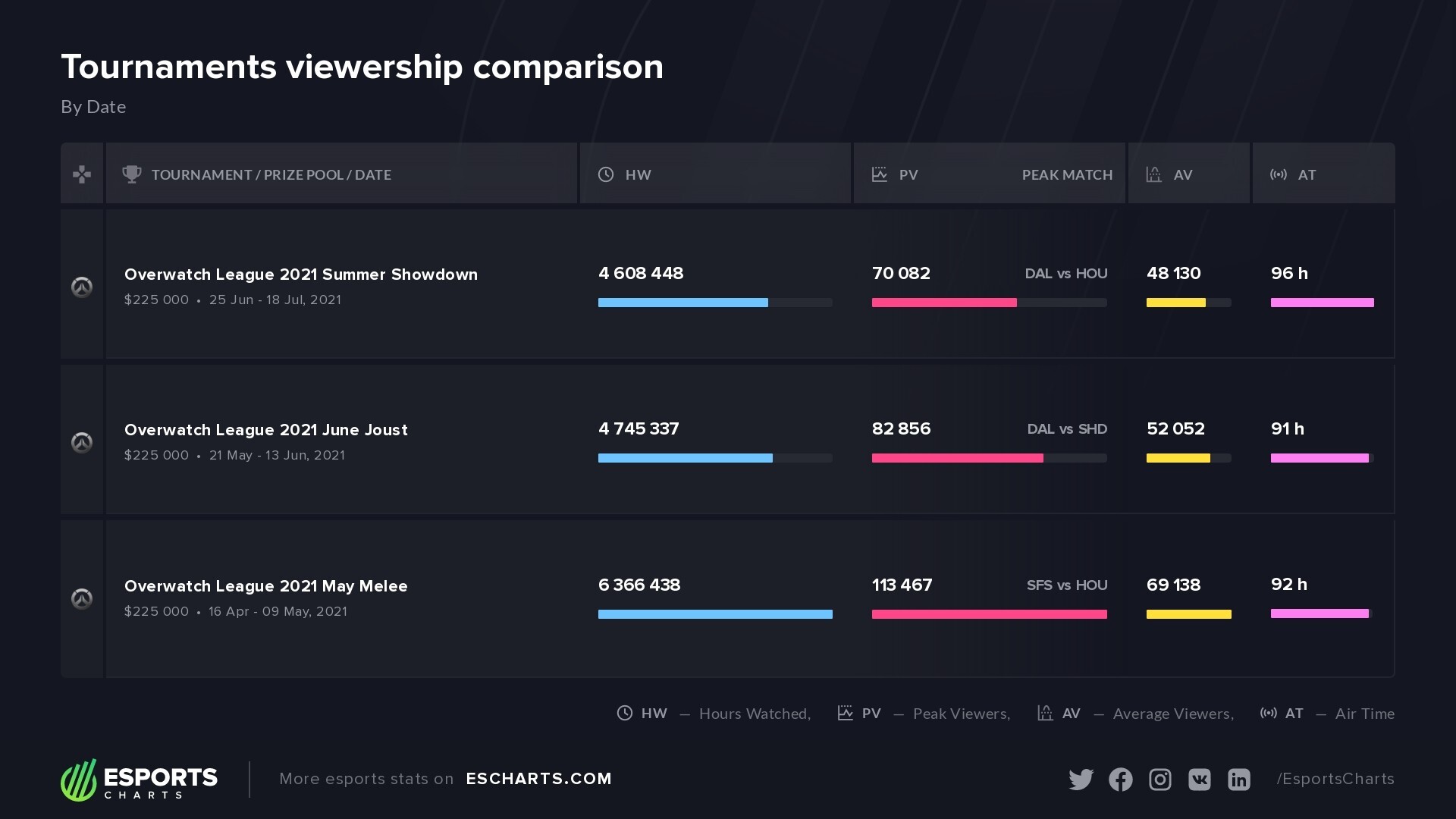
The tournament (qualifiers included), has marked a total of 4.6M Hours Watched, which is a 2.95% decrease compared to June Joust, and a 27.6% decrease compared to May Melee.
The declining trend is visible in other monitored metrics too. The event attracted 48K Average Viewers — that’s a 7.5% decrease compared to June Joust and a 30.4% decrease compared to May Melee. As for the Peak Viewers — note that the peak of 70K concurrent viewers was reached during the qualifier match between the Dallas Fuel and Houston Outlaws. In fact, four of the five most popular matches within the championship were qualifier matches.
Only one knockout match got into the chart — the Dallas Fuel vs. the Washington Justice semifinal match, which ended up in a second place with 68K Peak Viewers. The grand final match between Shanghai Dragons and Chengdu Hunters peaked at 60K concurrent viewers — a rather unexpected development, given that most tournaments’ grand finals usually attract the highest volumes of spectators and that this was the case also in previous seasons of the Overwatch League.
In comparison with the June Joust, the Peak Viewers count of the Summer Showdown decreased by 15.4%. Compared to May Melee, the number of Peak Viewers declined by 38.2%.
The popularity of teams at the OWL 2021 Summer Showdown was fairly balanced, with the top five teams reaching relatively similar numbers.

The team with the highest Average Viewers count — 57.86K AV, was Los Angeles Gladiators, who got eliminated by Atlanta Reign in the regional semifinals.
The second most-watched team of the tournament — Houston Outlaws, was spectated by 57.59K viewers on average. Next were Dallas Fuel with 56.57K AV and also the highest Hours Watched count of all teams. Toronto Defiant follow with 55.71K Average Viewers and the fifth spot is taken by San Francisco Shock with 54.94K AV.
The presented statistics show that the Overwatch League’s viewership is seeing a slow decline with each event of the 2021 season. However, rather than a new development, it’s a continuation of a gradual decline that the league has been seeing since the beginning of the last year. There are several reasons for this.
The first and the most obvious is the COVID-19 pandemic, which made Blizzard Entertainment revamp its league model. A season and a half later, the OWL’s viewership numbers are hardly comparable with the pre-pandemic in-person majors.
The second reason for the league’s declining popularity is the change of its official broadcaster from Twitch to YouTube, which took place in January 2020 and was followed by a significant drop in viewership numbers in the upcoming OWL season. This was presumably the catalyst that pushed the league on the declining path it’s been on ever since.
The third reason, which impacted only the two recent events — June Joust and Summer Showdown — has got to do with several format changes to the competition that the publisher introduced before the June Joust kicked off.
These changes include tiebreaker adjustments and Hero Pools — a rotation of playable heroes aiming to showcase more hero diversity and strategy in matches. As a part of the regulation, randomly selected heroes that had at least a 10% pick rate throughout the previous edition are removed from the pool, while each hero can be removed only once during the season.
Blizzard Entertainment’s structure adjustments weren’t met with much enthusiasm, mainly because such changes may have a strong impact on the game strategies of some of the teams and potentially shake up the odds of winning.
While the decline of the Overwatch League’s viewership continues, more questions arise: Will things get back to normal once the pandemic is over? Will the popularity of the league surge again, or have the aforementioned changes contributed to the league’s slow downfall? It might be too soon to jump to conclusions, so stay tuned for our reports from the upcoming OWL 2021 events.

Detailed Esports data at your fingertips.
Subscribe to & start exploring!


