

"Esports viewership is growing" — what does it actually mean?
Lately, it has become common to say that the esports industry is rapidly growing and developing. To some extent, this is true — every year more tournaments are held, new esports disciplines appear, the prize pools of world championships have long been counted in millions of dollars, and top gamers are catching up in popularity with sports and show business stars.
The audience of esports is also increasing — the battles of the best players and teams gather millions of viewers around the world. Peak viewership records of top disciplines are updated almost every year. The business aspect cannot be ignored — if previously the industry was supported by relatively small sponsor companies and peripheral equipment manufacturers for gamers, now esports falls under the interests of top investment companies, national banks, telecommunications holdings, and so on. It seems that not so long ago, the best tournament players received a personal trophy and a computer mouse, but now they are presented with a large check and a premium-class car.
When discussing the growth of the esports audience, it is important to understand that it does not grow by itself just over time — it is a very dynamic process that depends heavily not only on the specific game, but also on a platform, region, or language of broadcasts. Viewers' interests also change, and sometimes entire genres become outdated instead of specific games. Currently, Crossfire, Hearthstone, and Smite tournaments have virtually disappeared from the professional scene. Once popular disciplines can show stagnation for years, the industry will still compensate for this and develop through something else. The speed of growth and overall dynamics are also influenced by many external factors. For example, the most obvious of these is the coronavirus pandemic, which has caused a significant part of the industry to switch almost entirely online for two years. Another important factor is the development of technology: the launch of powerful and financially available gaming smartphones helped to arouse a whole industry of mobile esports in just a couple of years.
Dynamics of esports popularity in 2017-2022
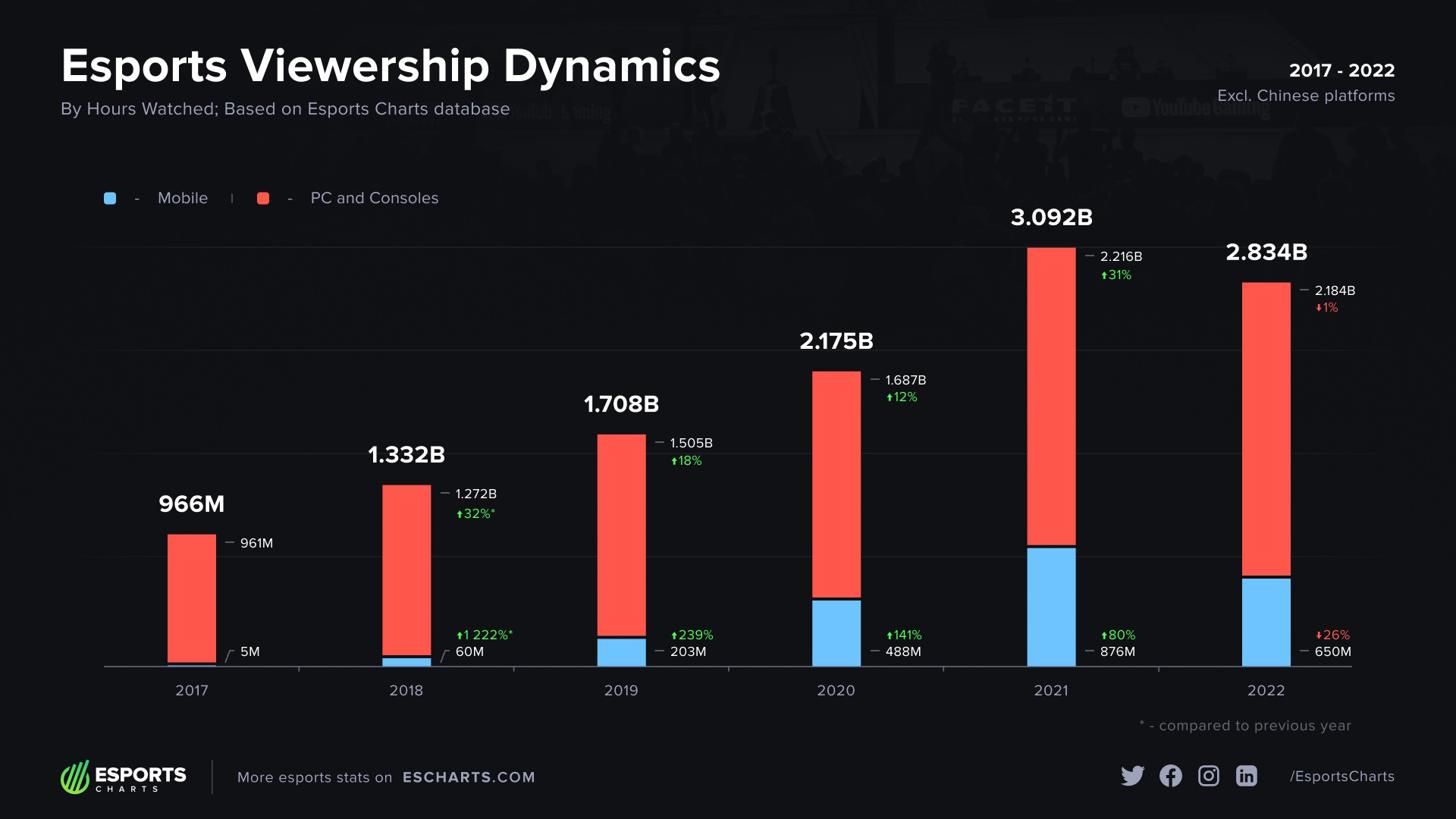
The audience coverage of esports tournaments has indeed greatly increased in recent years. In 2017, all events in total accumulated 966 million Hours Watched, and five years later, this figure has grown more than three times.
It is very interesting to compare the growth of the esports industry with the development of the mobile segment of esports. This niche of virtual entertainment appeared relatively recently — mobile titles’ tournaments accumulated their first million Hours Watched only in 2017. At that time, the audience coverage of mobile esports was almost imperceptible against the backdrop of classic esports competitions — only about 0.5% of the total Hours Watched. Over time, the situation has changed significantly.
The most productive year for esports so far is 2021, with tournaments amassing over 3 billion Hours Watched. In that year, the mobile gaming scene already accounted for 28.3% of the industry's total Hours Watched. This became possible thanks to popular titles such as PUBG Mobile, Free Fire, Mobile Legends: Bang Bang, and Arena of Valor.
In 2022, there was a slight decline in Hours Watched, with the industry accumulating 2.8 billion Hours Watched, approximately 6% fewer than the previous year. However, this decrease cannot be considered critical. One of the factors behind this drop is the esports situation in India. The local government has blocked access to many popular games (like PUBG Mobile), making it more difficult for esports to develop in the country.
To sum up, the growth of esports is usually associated with positive dynamics in some games and regions with falling statistics in others. The industry is really growing if you look at it at a long distance, but due to various factors (and different industry segments), the situation can be different from year to year, when both growth and fall of metrics can be traced.
Popularity of English broadcasts in esports
Different regions perceive esports differently. A typical gamer from Europe or the United States perceives esports as a competition on PC in classic titles like CS:GO, Dota 2, or League of Legends. Historically, the key language for covering these disciplines is English. However, if we look at the dynamics of total Hours Watched on English-language broadcasts in different years during the first quarters, we will not find either a significant increase or a fall of metrics.
Why are we comparing specifically the first quarters? At the beginning of the year, League of Legends, Dota 2, and CS:GO have approximately equal tournament schedules — this period traditionally coincides with the start of tournament seasons, regional leagues begin, and some major tournaments take place. As for world championships for these disciplines, they usually take place in the second half of the year.

Total Hours Watched for the first quarters in the League of Legends, Dota 2 and CS:GO disciplines
Even though English broadcasts of major disciplines gather more viewers each year, this growth can’t be labelled as crucial for the entire industry. Sometimes the aforementioned disciplines show good growth in total Hours Watched, but the following year, these indicators may decrease.
League of Legends is the clear leader by total Hours Watched on English broadcasts in Q1 2023. However, if we compare the first quarters of 2017, 2018, and 2019, it shared the top spot with CS:GO (and sometimes even lost to Valve's shooter). As for Dota 2, it has the lowest audience coverage in this trio in the long run. When comparing disciplines on a quarterly basis, 2023 has become the most successful year only for Dota 2, while CS:GO and League of Legends have shown better results in the past. Dota 2 growth is associated with the Lima Major in the first quarter of the year.
As we can see, each discipline shows different dynamics in different years. If assessing only the first quarters, the total Hours Watched number on English language broadcasts (mainly for them) increased from 121 million to 139 million during the period from 2017 to 2023. However, this growth is rather sporadic than even — during this period there were serious declines, down to 105 million in 2020. In other words, classic PC disciplines with ten years of history and their coverage of the English-speaking audience (mainly in North America and Europe) are not the main factors in the industry's growth. At the same time, these disciplines show decent audience reach in other languages. For example, Portuguese, Korean, Spanish, French, etc.
Competition of mobile and classic esports in different countries of Southeast Asia
The role of mobile esports in the industry's growth is undeniable, but it is also important to understand which countries and regions have contributed the most in this regard. Again, historically, large regions such as America and Europe are not particularly fond of mobile gaming. Classic esports disciplines, which are traditionally played on PCs or consoles, prevail there. However, in Southeast Asia, gamers and viewers are increasingly preferring mobile esports — largely thanks to its accessibility and proximity of publishers to this region.
In some Southeast Asian countries, mobile gaming is several times more popular than the classic one. This is especially evident in Indonesia, where the audience coverage of mobile esports has grown 5-6 times in the last three years. Mobile Legends: Bang Bang deserves great credit for this — the game is hugely popular in Indonesia, and local teams dominate international tournaments and have millions of followers on Instagram.

A similar situation is observed with mobile esports in the Philippines. Until 2020, local viewers were much more interested in classic esports, but from 2021, their attention switched to mobile titles. Currently, broadcasts of mobile games tournaments in Tagalog accumulate 5-6 times more Hours Watched than classic PC disciplines.
In Thailand, there is a reverse situation — the position of mobile gaming in this country has always been strong, but from 2021 onwards, the audience coverage of classic disciplines began to grow (thanks to PUBG: Battlegrounds and Valorant).

Vietnam is one of those countries where the popularity of mobile esports has been gradually growing in recent years. At the same time, classic disciplines are still accumulating more Hours Watched, but this situation may change in the near future. Currently, the shares of mobile and classic esports in the total number of Hours Watched of broadcasts are almost equal.
The popularity of mobile esports in Southeast Asia has a big impact on the growth of the entire esports industry. This region is currently the most progressive, and local gamers and viewers are the most open to new titles. However, large markets such as Brazil and Latin America should not be ignored — they are also promising and deserve in-depth analysis in another article. As for America and Europe, local gamers prefer classic PC disciplines and almost ignore mobile esports.
***
When it comes to the viewership growth of esports, it is important to understand that the growth of the entire industry is directly related to the growth of its individual segments — and not always those that form the basis of the industry. The largest and worldwide popular games may not grow at the highest rates, while sharp jumps in popularity are made by local games and language segments.
The English-speaking segment of the esports audience is one of, if not the key in the industry, but its growth rate is far from the highest when compared to other regions such as Southeast Asia. While PC and console games still dominate the industry, the mobile esports segment is also growing due to the large regional influence — and now it is approaching about 30% of the industry's total (excluding China).
In summary, the analysis of the dynamics of esports audience indicators should be comprehensive, it should reflect the influence of different industry segments and pay attention to specific growth drivers. Without this, it is impossible to really understand what is happening in the industry.
Over the seven years of operation, Esports Charts has established itself as an industry leader in the collection and analysis of esports statistics. If you are interested in learning more about the audience of tournaments, the dynamics of individual disciplines, regions, and broadcast languages, you can reach out to us via the contact form.

Detailed Esports data at your fingertips.
Subscribe to & start exploring!


