

CS:GO online era started over a year ago: how did it affect viewership statistics of the discipline?
In the spring of 2019, the world was shocked by the coronavirus pandemic. This changed everything, including esports which had to urgently adapt to the new reality. The disciplines that are considered to be international (due to the weak geographic attachment to certain countries or regions) suffered especially hard and CS:GO is the most striking example here. But in addition to the problems, the esports scene of the shooter also got new opportunities and the audience of tournaments has begun to grow. Does this trend continue to this day? Who benefited the most from the “Online era”? And what is about to happen next?

Scroll through the article to see more infographics with CS:GO Esports viewership analytics

What happened to the CS:GO esports scene during pandemic?
The main advantages of Counter-Strike: Global Offensive as an esports discipline have always been stability and predictability. For almost the entire history of the game, it has evolved thanks to the excellent synergy between publisher Valve and the tournament operators. Valve mostly keeps away from risky experiments with the game (both in terms of gameplay and its business model) and allows it to grow on its own. TOs are precisely the drivers of the growth of the discipline: they hold competitions and attract sponsors, thus becoming the key actors in the CS:GO esports landscape. In a word, the system is built, and it works: the calendar of events is known in advance, all parties know what to expect from each other. But with COVID-19, everything began to change very rapidly.
The number of tournaments has decreased. One of the main features of Counter-Strike is that it is an international discipline; and until recently its tournaments took place all over the world from China to Brazil. In two months the strongest teams could have attended championships on three different continents, but this became impossible during the pandemic. As a result, tournament operators began to cancel and/or postpone their championships, and some companies even disappeared from the scene. The most striking example here is StarLadder: in 2019 it seemed that the company would be the one of if not the main competitor to ESL in the market, but with COVID-19 it actually suspended its activities, and held its first tournament after the coronavirus outburst only in the summer of 2021. Thus, earlier one could have named at least 3-4 big TOs, but now this number has decreased to only two companies: ESL and BLAST.

StarSeries & i-League CS:GO Season 8 is the last truly big event by StarLadder. At least for now.
Regionalization of the scene. With the onset of the coronavirus, the world went into global quarantine. As a result, the teams were locked in their regions and this has never happened in the entire history of CS:GO. One should say that Europe almost did not suffer (the competitions here were always of the highest level), but the scenes of North America and Asia were on the verge of extinction: there are a few really strong and popular teams, but the majority of the competitors are not that interesting to the public. Obviously, this is bad for everyone: lesser known teams are not of great interest either for the audience, sponsors or local grands. Only by the end of 2020 did the leaders of the scene realize that if they want to stay in the discipline, then they need to move to Europe. It is there that all the largest competitions are now taking place with the participation of the most prominent teams from America, Asia and Oceania. The rest were left behind.
The real power level of teams became vague. CS:GO enthusiasts are very fond of dividing teams into ‘tiers’ in accordance with their own ideas about the strength of squads. The problem is that this categorization has always been very conditional; and with the onset of the coronavirus the task has become even more complicated, because the scene began to resemble a melting pot, where everyone plays with everyone, and yesterday's “giants” are on a par with “onliners”. The last year and a half, only two teams have been most consistent: Natus Vincere and Gambit Esports, while the rest are quite unstable. For example, G2 Esports team, which is now the third in the HLTV rankings, has been on both the 1st and the 14th places during the last 1,5 years. One should also remember, that with the return of LAN things will get even more confusing: not all “onliners” will be able to pass the test of offline competitions.
Valorant takes advantage of CS:GO issues. Counter-Strike is challenged not only by the problems caused by the coronavirus, but also by competitors. And this primarily applies to Valorant by Riot Games, which actively burst into esports in 2021. Surely, so far the game cannot fully compete with CS:GO, but it is gradually gaining ground on different fronts.
Firstly, there are a lot of prominent CS:GO players who are actively leaving for Valorant: this applies to the vast majority of talents from North America, the same is done by some European esports players: ScreaM, Hiko, TenZ, NBK-, Skadoodle and many, many others.
Secondly, Riot Games is actively working to get an audience in countries and regions where CS:GO is not the undisputed leader among team-based competitive shooters. The esports Valorant started very well in Asia and especially in Turkey: the first tournaments there are already gathering hundreds of thousands of spectators and it looks like this is just the beginning.
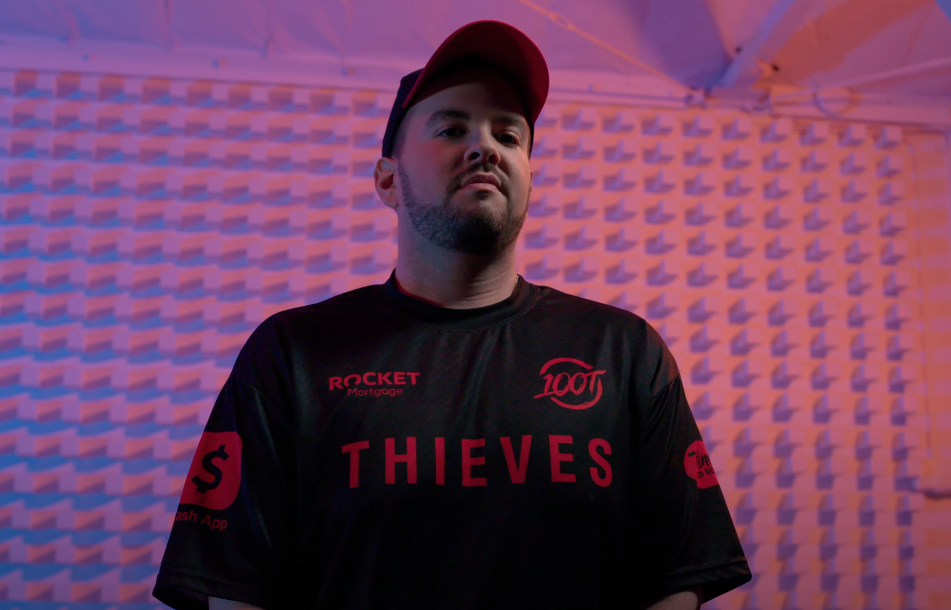
Hiko found himself a new home in Valorant: both as a streamer and an esports athlete
To sum it all up, the pandemic has significantly changed the usual order of things on the CS:GO scene: traditional LAN competitions have disappeared, players are constantly complaining about ‘Groundhog Day’ and the burnout from endless online tournaments. But despite all the problems, CS:GO only manages to increase the audience of the competitions! So, how much has discipline views grown in new COVID reality?
Viewership dynamics of CS:GO esports: pandemic can’t prevent the growth of discipline
Counter-Strike missed Majors for two whole years. It would seem that the discipline is doomed to a slow but inevitable decline in viewers' interest without such big tournaments. But in practice, it turned out exactly the opposite.

We examined the indicators of CS:GO esports by quarters for the last three years (statistics for 2021 take into account the indicators for the first 7.5 months of the competition). As can be seen from the graph, in 2020-2021 the discipline has grown in the amount of Hours Watched metric: on the one hand, this is explained by the growth of the airtime of the championships, but the main reason is still that there are simply more viewers on broadcasts than before.
The most successful period for discipline during this time was April-June of 2020. In total, viewers spent over 125 million hours watching tournaments over these three months, almost 30% more than in the most successful quarter of 2019. Such a significant increase is not accidental: it was in the late spring / early summer of 2020 when many tournaments took place, including the first Regional Major Rankings events (they replaced the Minors) with all the top teams in the world taking part in these competitions.
Although viewers began to spend more time watching tournaments, there were no new records by peak viewers numbers: ELEAGUE Major 2017 still holds the lead with 1.33 million simultaneous viewers at peak. In addition, none of the tournaments that have taken place over the past year and a half were able to bypass the first major of 2019 by peak viewers. But there were other memorable achievements: for example, IEM Katowice 2020 at its peak gathered more than a million viewers and, according to this indicator, entered the top five most popular tournaments of the discipline. In July 2021, the first significant LAN took place (without live audience), the grand final of IEM Cologne at its peak gathered over 843 thousand people and thus bypassed the last major at the moment: StarLadder Berlin Major.
Lack of Majors is not a problem
Traditionally, it is the CS:GO majors that gather the maximum viewers among all the discipline's tournaments (largely due to the rare collectibles that can be obtained for watching matches). Before the pandemic, the six most popular tournaments in the history of the game were exclusively majors, but during the pandemic four online tournaments entered the top 10. Some of the events even surpassed the Berlin Major '19 and the Krakow Major '17 by peak number of viewers.

Let’s also consider a graph comparing the last three years by months. As one can see, the periods from March to the end of June during the last two pandemic years turned out to be significantly more successful in terms of the amount of hours watched compared to 2019. At the same time, due to the changes in the calendar of tournaments and player breaks, the discipline managed to increase its indicators in months when there were almost no tournaments before.
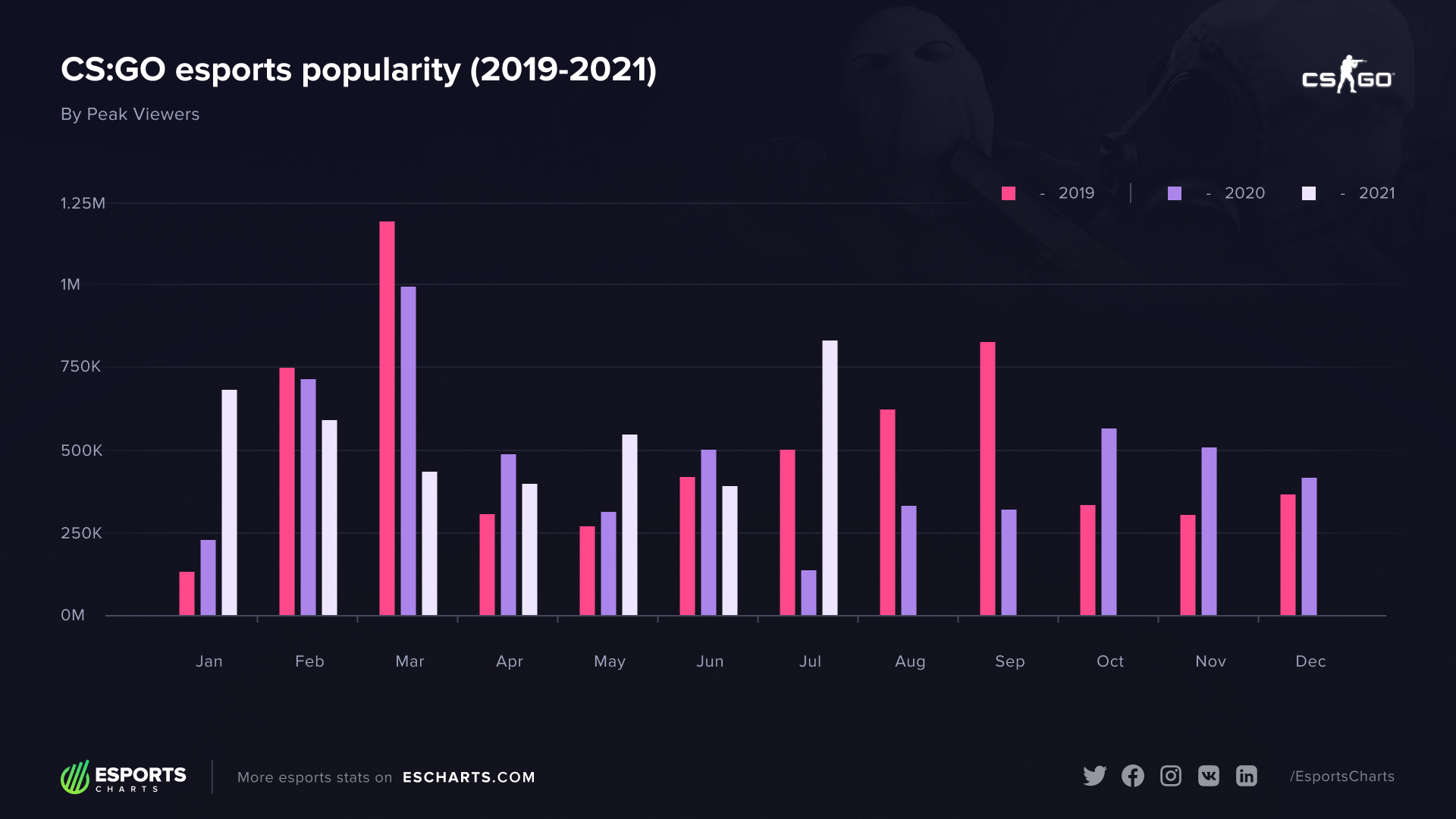
A similar situation is observed when comparing the peak number of viewers by month over the past three years. On the one hand, no other tournament has yet surpassed IEM Katowice Major 2019 in this metric, but the discipline has improved in other time periods: for example, January of 2021 was almost three times more successful than the latter of 2019 and 2020. Likewise, July of 2021 was the most successful in three years.

Let's look at the chart of tier-1 tournaments’ popularity in the last three years (with prize funds of $100,000 or more). As one can observe, no championship can compete with the majors so far. But at the same time, no other top tournament of 2019 made it to the top 10: the online championships of the last 1.5 years finished from 3rd to 10th places.

Due to the pandemic, Valve had to rethink the qualifying system for Majors. As a result, the pool of top tier-2 tournaments (with prize pools from $20,000 to $100,000) included the most popular competitions of the RMR series. Flashpoint Season 3 turned out to be the most successful tier-2 tournament in recent years; in terms of the total number of hours watched, it can be compared to the biggest tournaments of the discipline.

Qualifications for the biggest championships are still the most popular among the tier-3 events (prize funds up to $20,000). But during the pandemic RMR tournaments for South America also became quite successful: this region received its own qualifiers for the Major only during the pandemic (although it is Brazilian CS:GO fans who have made up a significant part of the discipline's total viewers number for quite a long time now).
It should be noted that there’s the same number of 2020 and 2021 tournaments in the charts compared by the number of hours watched. However, in comparison with other metrics (average / peak viewers), it is the championships of the current year that are ahead. In short, viewers' interest in competitive CS:GO is only growing.
Haters have been saying that CS: GO is dying for several years now, but in reality the situation is exactly the opposite: viewers' interest in the competition only grew during the pandemic. Championships with a simultaneous audience of more than 400,000 people used to be a rarity, but now almost every tier-1 tournament gathers that many viewers. Some of the most popular teams (G2 among English-speaking viewers, NAVI among Russian-speaking audience, FURIA and MIBR among Brazilians) make a significant contribution to these impressive numbers, but fans actively follow the tournaments even without them. Most importantly, Counter-Strike attracts hundreds of thousands of viewers without majors and regular LAN tournaments, which will be back soon! This means that by the end of the year the game will strengthen even more by key metrics. An amazing result for a shooter that will turn 10 years old next year!

Detailed Esports data at your fingertips.
Subscribe to & start exploring!


