

Mobile Legends: What is this game, and why are top esports teams heading there?
Recently, Mobile Legends: Bang Bang (MLBB) has been getting much attention in the global media, led by its record-breaking events and the increasing participation of well-established Western esports organizations. This has also meant that more and more players across the world are starting to see how big a deal it is, something fans in Asia are already well aware of.
Released in 2016, the game has achieved staggering numbers over the years, with its lifetime app downloads surpassing 641 million worldwide as of December 2024. It continues to attract fresh audiences, drawing in approximately 7.6 million new users in the final month of last year alone, underscoring its enduring appeal. These impressive figures have cemented MLBB's status as one of the most popular and widely played mobile games globally.
Why has a game that remains relatively under the radar in the West suddenly generated so much buzz, despite being one of the most popular and played titles worldwide? Here's a breakdown of MLBB, its esports ecosystem, and the factors that make it so compelling for global audiences and analysts.
Release and Legal Disputes with Riot Games
MLBB was developed and published by Chinese developer Moonton, a subsidiary of ByteDance, a Chinese internet technology company known for developing TikTok. This mobile multiplayer online battle arena (MOBA) title instantly found worldwide fame, becoming especially prominent in Southeast Asian countries like Indonesia and the Philippines.
It is also well-liked in other SEA nations like Thailand, Vietnam, and Taiwan but is not the most popular game in these nations.
Soon after launching, MLBB found itself in an intense legal battle with Riot Games, who accused Moonton of copyright infringement and plagiarizing the new game from its own famous PC MOBA, League of Legends (released a few years earlier). The battle raged on for eight years before Riot dropped its claims against the Shanghai-based studio in 2024, with the two agreeing to a settlement.
This legal dispute also translated to a battle for player supremacy, with both parties especially battling for the attention of the lucrative Southeast Asian market. Eventually, MLBB came out on top by better serving fans' needs and attracting the attention of the crucial Indonesian and Filipino markets.
After all, its mobile-accessible gameplay makes it the perfect candidate for a region that relies heavily on smartphone devices compared to the more developed countries in the West.

The matches are also much shorter than those seen on LoL, which appeals more to a player base in Asia that has a fast-paced lifestyle. Moonton has also been smart in adapting the game to each regional culture, be it by translating the game into multiple languages like Thai, Indonesian, Filipino, and Bahasa or involving local celebrities and influencers for its events and collaborations.
Moreover, to foster player identification, a lot of the heroes introduced in Mobile Legends: Bang Bang have localized designs, borrowing from the mythology and historical figures of various Southeast Asian countries. Since these characters carry stories that have been passed on for generations, thus resonating with fans' cultural identities, national pride, and regional heritage, the game has cultivated a strong connection with its SEA audience.
Of course, being popular among locals is not enough if a game wants its esports ecosystem to thrive worldwide. That is where the success of teams from the region, especially Indonesia and the Philippines, on the international stage has helped attract a large number of players to the title, giving SEA fans a sense of accomplishment and attachment to MLBB.
Mobile Legends: Bang Bang Esports
MLBBs first few esports seasons were barely a whisper in the global competitive video gaming community. The MLBB Southeast Asia Cup 2017 was the first-ever official major hosted by Moonton. Featuring the eight best teams from the SEA region, the MSC was held over just three days, and Thailand's IDONOTSLEEP Esports came out on top to etch its name in the game's early competitive history.
While the tournament's viewership numbers were decent, they were pretty remarkable for a first-time event in the still-fledgling mobile esports bracket. This convinced Moonton to go all in and conceptualize plans for a world championship (which would later become the M series), but to get there, the game needed a proper structure.

That is where the Mobile Legends Professional League (MPL) came into the picture as circuits for Indonesia, Malaysia/Singapore, and the Philippines were introduced in 2018. With these regional series proving to be highly successful, Myanmar (2018), Brazil, Cambodia (both 2021), and the Middle East and North Africa (MENA, 2022) got separate circuits over the next few years. Singapore and Malaysia were also split up and got their own top-tier MLBB competitions in 2021.
With a solid structure now in place, 2019 saw M1, the first world championship, emanate from Kuala Lumpur, Malaysia, with Indonesia's EVOS Legends creating history as the game's first world champion. Crucially, this team — also called EVOS Glory — would become one of the biggest esports organizations in MLBB, winning the MPL Indonesia Season 7 and finishing on the podium multiple times in the regional league and other global tournaments.
At the end of the MLBB World Championship 2019, the game was still in its nascent viewership stage. It only crossed the one million Peak Viewers (PV) mark for the first time at the MPL Indonesia Season 6 in 2020. This was the turning point, with the maiden M series competition to pass this barrier coming soon after at the M2 World Championship.
The success of teams from Indonesia and the Philippines has guided this development in audience reach, with pro gamers also becoming mini-celebrities as more and more viewers get hooked on watching and playing the game. Crucially, the dominance of two nations from this region at the world championship has helped give fans in this region a sense of accomplishment and belonging on a global scale.

Since then, the MLBB esports scene has been an intense, year-long battle among the various teams and regions. Aside from the MPLs and MSCs, fans have also seen the emergence of third-party organizers like Snapdragon. The tech giant's Snapdragon Pro Series is the world's largest multi-genre mobile esports competition and has recently produced milestone events like the Snapdragon Pro Series Season 6.
However, the MPL remains the game's lifeblood, with the Indonesian circuit growing into one of the biggest non-global series in esports. There are also similar series in regions like North America (North America Challenger Tournament), Eastern Europe/CIS (MLBB Continental Championships), and Turkey (MTC Turkiye Championship), which are not in the same tier but contribute to the game's global reach and count towards participation at international tournaments.
No team is bigger than Indonesia's RRQ Hoshi, the title's most popular side and the inaugural world championship runner-up. Then there are EVOS and Blacklist International, both former world champions who have helped elevate the game's global reputation by giving it a meaty rivalry on its grandest stage.
After all, the battle between the Philippines and Indonesia to see which country maintains a stranglehold on MLBBs most coveted prize has become a running plotline with the arrival of each M series event. It helps that no other nation, apart from these two, has won the world championship over its first six editions.
We also saw the entry of several high-profile non-SEA organizations into MLBB in 2024, like Team Falcons and Team Spirit, alongside famous Western companies such as Fnatic, and Team Liquid. Crucially, it was the latter two names who caught the attention of the community with their left-field choices.
Team Liquid acquired the Southeast Asian esports organization STUN.GG and its esports properties: AURA Esports and ECHO Esports. The latter was one of the most successful Indonesian teams, which was also why the roster, under the new branding of Team Liquid ID, won the MPL Indonesia Season 14 and came second at the M6 World Championship.
Fnatic, meanwhile, arranged a year-long partnership with the well-established ONIC Philippines. The roster's experience was immense, and that helped it end the season on a high by clinching the world championship and maintaining the Philippines' recent dominance of the event.
These Western sides were also exposed to new audiences in the Eastern hemisphere. Both Team Liquid and Fnatic, thanks to the popularity of ONIC and ECHO in Southeast Asia, pulled in more eyeballs, especially from the Southeast Asian region, helping them finish among the year's most-watched esports organizations.
MLBB's 2024 Viewership
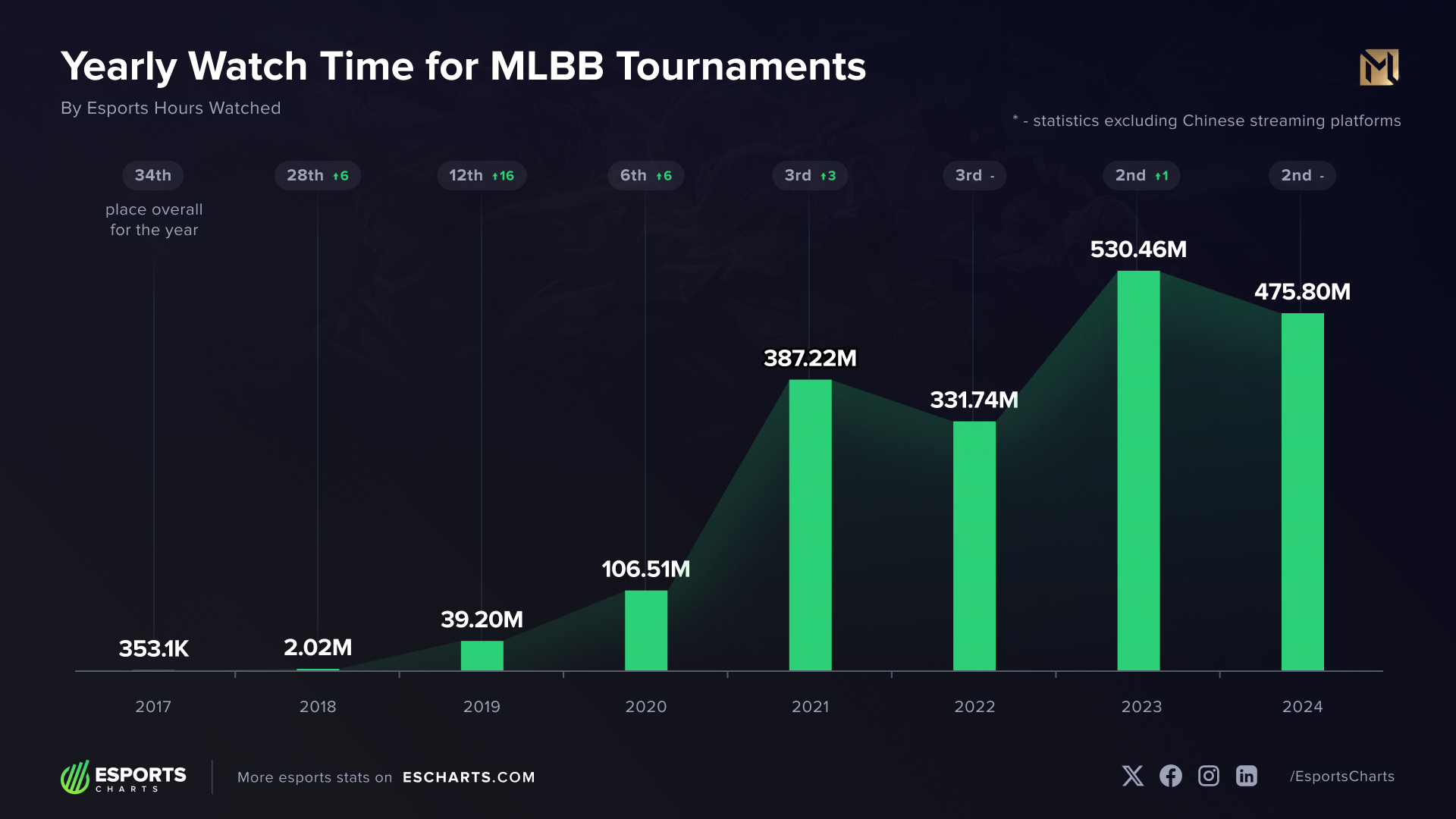
The game's audience reach since the pandemic years has witnessed a substantial surge, with each subsequent world championship between 2020 and 2023 improving on its PV numbers. The only comparable game is League of Legends, whose own world championship has become a spectacle over the past two years thanks to the introduction of co-casting and the sheer number of storylines between players, teams, and regions.
Compared to other MOBAs, MLBB stands tall as the most popular game. The next-best mobile game in the genre was Brawl Stars, the only other name to see growth in the mobile esports segment last year. The third-person hero shooter's 2024 World Finals enjoyed a massive surge in audience interest and ended as the year's second-most popular event in the genre, a full 274.3% behind MLBB's top competition.
Meanwhile, the viewership statistics of Wild Rift, the mobile version of LoL, were barely able to leave a mark on the esports scene. Its most popular tournament turned out to be the Wild Rift League Asia 2023 Season 2, which peaked at just under ten thousand viewers.

In fact, a list of the eight most popular esports competitions of all time consists of three entries from MLBB (only LoL has more, with four), showing how much better the mobile MOBA performs compared to other games. None of the other famous titles that have done well over a certain period, like Dota 2 and Counter-Strike, have matched these PV numbers over the past 12 months, and even before that.
MLBB has never seemed like a more lucrative prospect to prominent esports stakeholders and organizations than in 2025, especially to those in the West. Its stock has shot up after a great 2024 season, and with the likes of Team Liquid and Fnatic finding almost immediate success, there's no reason why other companies from outside the dominant SEA region cannot come in and do the same. With Moonton looking to make the game more exciting and appeal to a broader audience and player base, the community is in for an intriguing next 12 months.

Detailed Esports data at your fingertips.
Subscribe to & start exploring!
Mentioned events


For complete tournament statistics, visit the dedicated event pages on Esports Charts
Mentioned teams


Newsfeed


